

We’re cutting through the business noise. The lean startup methodology isn’t just another buzzword. It’s a proven framework that reshapes how companies build successful products. Eric Ries codified this approach in 2008 after learning from his own failures.
Traditional business planning often fails. Teams spend years in secret development. They burn through capital launching “perfect” products. This conventional wisdom leads to more misses than hits.
The lean startup methodology challenges this outdated thinking. It prioritizes rapid experimentation over elaborate planning. Validated learning replaces assumptions. Customer feedback trumps intuition.
In 2025, this approach matters more than ever. Market conditions shift rapidly. Customer expectations evolve constantly. Resources remain precious regardless of funding levels.
We see established companies and new ventures adopting these principles. They deliver measurable results: reduced time to market, lower development costs, higher product-market fit. This isn’t theoretical—entrepreneurs using this framework have built billion-dollar businesses.
Key Takeaways
- The lean startup methodology emerged from Eric Ries’s real-world business failures and successes
- Traditional lengthy planning cycles often lead to product-market mismatch
- Rapid experimentation replaces assumptions with validated customer learning
- This approach reduces risk and conserves resources in uncertain markets
- Both startups and established companies achieve better results with this framework
- The methodology treats business ideas as testable hypotheses rather than certainties
- Evidence-based pivoting leads to higher success rates than gut-feeling decisions
Understanding the Lean Startup Methodology
The genesis of this powerful framework lies not in academic theory, but in the hard lessons of real-world business failure. Eric Ries didn’t create this model from an ivory tower. He built it from the ashes of his own ventures that crashed despite massive funding and long development cycles.
Origin and Evolution
Ries experienced significant failures, like There, Inc., which burned through $40 million over five years. These ventures failed for a common reason: building products without first understanding customer needs.
This pain led Ries to integrate Steve Blank’s customer development framework with lean manufacturing principles from Toyota. The core idea was simple yet radical: eliminate waste by testing hypotheses with customers early and often.
Core Principles and Benefits
The core principles are deceptively simple. Treat your business plan as a set of unproven assumptions. Prioritize validated learning over elaborate execution. Embrace rapid experimentation instead of rigid planning.
The benefits are measurable and significant. Companies using this approach often cut product development cycles by 50% or more. They achieve higher product-market fit by building what customers actually want.
This represents a fundamental mindset shift. It moves from “build it and they will come” to “learn what they want, then build it.” This distinction is often the primary factor between success and failure.
Modern Approaches for Today’s Startups
Market dynamics in 2025 operate at unprecedented speeds, making agility the new competitive advantage. We see this framework expanding far beyond its Silicon Valley origins.
Government agencies, Fortune 500 companies, and academic institutions now embrace these principles. They work across diverse industries because they deliver measurable results.
Embracing an Agile and Lean Mindset
This mindset requires accepting that initial ideas will evolve. Change isn’t failure—it’s the process working as designed. Traditional industries like healthcare and finance now lead adoption.
Three mental shifts define this approach: prioritize learning speed over execution speed, value customer feedback over internal opinions, and treat decisions as reversible until data proves otherwise.
| Aspect | Traditional Approach | Modern Approach | Business Impact |
|---|---|---|---|
| Iteration Cycle | Quarterly or annual | Weekly or monthly | Faster market adaptation |
| Resource Allocation | Based on assumptions | Based on validated learning | Higher ROI efficiency |
| Risk Management | Avoid failure at all costs | Embrace controlled experimentation | Lower catastrophic risk |
| Customer Engagement | Post-launch feedback | Continuous validation | Higher product-market fit |
| Decision Framework | Intuition and convention | Data-driven hypotheses | More reliable outcomes |
Time compression creates dominance. Companies iterating weekly outperform quarterly competitors. Entrepreneurs combine this with design thinking and growth hacking for hybrid solutions.
Crowded markets and demanding customers make this approach essential. It represents strategic resource allocation, not resource starvation. The process delivers innovation while managing risk effectively.
Essential Components of the Lean Startup Process
Three interconnected elements form the operational backbone of this business approach. We see these components working together to transform uncertainty into actionable intelligence.
Build-Measure-Learn Framework
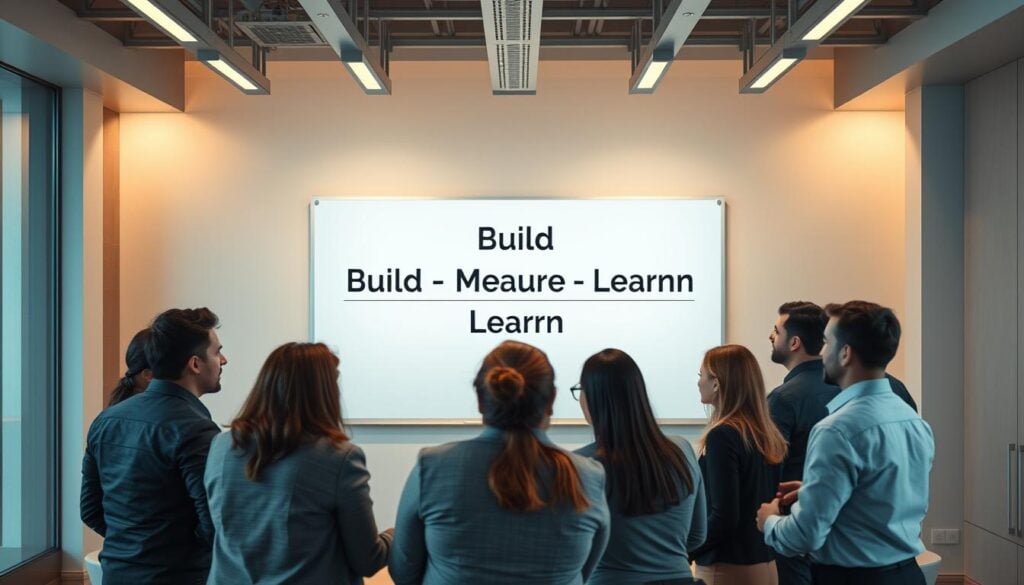
The core cycle drives continuous improvement. Build the simplest version that tests your riskiest assumption. Measure what actually happens through defined metrics. Learn from the data to inform your next move.
This feedback loop must operate rapidly. Companies deploying updates frequently gain competitive advantages through accelerated learning.
Minimum Viable Product Strategy
A minimum viable product is not a stripped-down version. It’s the fastest way to test a specific hypothesis with real customers. Zappos validated demand by manually photographing shoes before building infrastructure.
This approach focuses on collecting maximum validated learning with minimal effort. The goal is testing value hypotheses before committing resources.
Data-Driven Decision Making
Actionable metrics separate successful ventures from failures. Total users mean nothing if acquisition costs exceed lifetime value. We prioritize metrics that drive business decisions.
Split testing eliminates guesswork by revealing actual customer preferences. Features get prioritized based on behavioral data, not internal opinions.
Implementing Lean Startup Methodology in Business Today
The implementation phase separates theoretical frameworks from practical business results. We see companies achieving dramatically different outcomes based on their execution approach.

Modern implementation means rejecting the traditional playbook entirely. Forget about 50-page business plans that become outdated before implementation begins. Instead, we start with testable hypotheses and evidence-based iteration.
Strategies for Resource Optimization
Resource optimization isn’t about being cheap—it’s about strategic allocation based on validated learning. We spend aggressively on what works and cut ruthlessly what doesn’t. Everything in between gets tested.
The best organizations combine lean principles with smart resource management. They rent equipment instead of buying, use shared services, and leverage contractors for non-core functions. This maintains cash runway for validated opportunities.
Comparing with Traditional Models
The fundamental difference comes down to timing. Traditional models plan extensively then execute. Lean models execute minimally then plan based on actual results.
Traditional business plans project five-year financials based on assumptions. The lean approach treats those same assumptions as hypotheses requiring immediate market testing. This eliminates the most common failure mode: building products nobody wants.
Management practices must align with the methodology. Traditional command-and-control structures fail when rapid iteration is required. Autonomous teams with clear metrics deliver superior results.
Time efficiency creates compounding advantages. Companies validating assumptions in weeks rather than months can test 10x more business models annually. This dramatically increases the probability of finding product-market fit.
Real-World Applications and Success Stories
Success stories reveal more than theory ever could. We see billion-dollar companies built from simple tests rather than elaborate plans. These examples demonstrate the framework’s power across diverse industries.

Zappos began with photographs, not warehouses. Founder Nick Swinmurn tested one assumption: will customers buy shoes online? He manually fulfilled orders before building infrastructure. This minimal approach validated the entire business model.
Groupon’s pivot shows the power of customer feedback. Their original platform gained little traction. The founders then tested a simple coupon promotion using a WordPress blog. Twenty redemptions proved the concept’s viability.
Case Studies and Industry Lessons
These companies share a common pattern. They treat business ideas as hypotheses requiring market validation. Customer input drives every successful innovation.
The approach extends beyond technology sectors. Manufacturing firms test new product lines with minimal versions. Healthcare organizations prototype service models before full implementation. Even government agencies achieve better results.
| Company | Initial Test | Key Learning | Final Outcome |
|---|---|---|---|
| Zappos | Manual shoe sales | Online demand existed | Billion-dollar acquisition |
| Groupon | Local pizza coupon | Group buying worked | Rapid scaling to IPO |
| IMVU | Early customer development | Social features valued | Successful virtual goods platform |
| U.S. HHS | Service prototypes | Citizen engagement critical | More effective programs |
The lesson is clear: speed of learning beats speed of execution. Market validation must come before scaling. Companies that systematically experiment achieve measurable success.
Future Trends and Adaptations in Startup Methodology
Government agencies now embrace what was once considered startup territory. Programs like Hacking for Defense prove the framework’s versatility beyond commercial applications.
University students apply these principles to solve national security challenges. This demonstrates the approach works for complex, high-stakes problems.
Emerging Innovations
We see specialized applications across diverse fields. Hardware development adapts rapid iteration despite longer manufacturing cycles.
Techniques like 3D printing and pre-order validation transform physical product creation. Entrepreneurs test assumptions before major tooling investments.
The criticism that this approach over-emphasizes cost-cutting misses the strategic point. True efficiency means eliminating waste while properly funding validated opportunities.
| Approach Type | Business Impact | Implementation Speed | Validation Method |
|---|---|---|---|
| Traditional Hardware | High capital risk | 6-12 months | Post-production feedback |
| Lean Hardware | Reduced waste | 2-4 months | Pre-order testing |
| Government Innovation | Better resource use | Weeks vs. years | Rapid prototyping |
| Academic Research | Faster commercialization | Accelerated cycles | Market validation |
Preparing for 2025 and Beyond
Successful entrepreneurs integrate emerging technologies with core principles. AI-powered analytics accelerate measurement phases dramatically.
No-code platforms speed building while advanced testing enhances learning. The fundamental Build-Measure-Learn loop remains constant.
We expect continued refinement of metrics frameworks and scaling strategies. Master the fundamentals while staying flexible for future advancements.
Conclusion
Business success in 2025 demands more than just good ideas; it requires disciplined validation and rapid adaptation. The evidence overwhelmingly favors systematic experimentation over traditional planning cycles.
Customer feedback drives every critical decision—from product features to resource allocation. This approach ensures companies build what people actually want, not what they assume customers need.
Your next step is clear: identify your riskiest assumption and design the simplest test. Measure results objectively, then act decisively on what you learn. This disciplined process separates successful ventures from failed experiments.
FAQ
What is the main goal of the Lean Startup approach?
The primary goal is to eliminate wasted time and resources by building a business model around validated learning. We focus on creating a minimum viable product to test core assumptions with real customers quickly. This process helps entrepreneurs discover what the market truly needs before making large investments.
How does the Build-Measure-Learn feedback loop work?
It’s a continuous cycle. First, you build a minimum version of your product. Then, you measure how customers use it and collect quantitative and qualitative data. Finally, you learn from that feedback to make informed decisions—either to pivot the strategy or persevere with the current plan.
Is this methodology only for tech companies?
Absolutely not. While popularized by tech entrepreneurs like Eric Ries, the principles of customer development and iterative testing apply to any industry. Any business, from retail to service-based companies, can use this method to innovate efficiently and reduce the risk of product failure.
What is the biggest mistake entrepreneurs make when adopting this method?
The most common error is building an MVP that is too complex. The goal is the minimum set of features needed to learn, not to launch a perfect product. Another mistake is ignoring the data or failing to pivot when the feedback clearly indicates a change is necessary.
How do you measure success with Lean Startup metrics?
Success isn’t measured by traditional vanity metrics like downloads or page views. Instead, we focus on actionable metrics that demonstrate real progress toward a sustainable business. This includes customer retention rates, conversion funnels, and validated learning about customer behaviors and needs.
Can established companies use these principles?
Yes, this is often called intrapreneurship or corporate innovation. Large organizations use these principles to foster a culture of experimentation. They create small, autonomous teams to test new ideas with the same rigor as a startup, helping them stay agile and competitive in a changing market.