
A silent crisis drains $359 billion yearly from American businesses. This isn’t a market crash; it’s the staggering cost of unresolved team friction. When tension goes unaddressed, productivity and morale plummet.
Data reveals a troubling pattern: 53% of employees handle toxic situations by avoiding them. This avoidance isn’t free. Each difficult conversation that gets sidelined costs an organization an average of $7,500 and more than seven workdays.
The shift to distributed work has intensified this challenge. Remote and hybrid environments remove the natural, informal cues of face-to-face interaction. This makes traditional workplace dynamics more complex.
We built this guide to cut through the noise. Our focus is on actionable, evidence-based strategies that deliver real results for modern teams. This isn’t about theory; it’s about practical frameworks you can implement immediately.
Our goal is to help you channel disagreement into productive outcomes. You will learn to transform team tension from a liability into a strategic advantage that strengthens cohesion and drives performance.
Key Takeaways
- Unresolved team issues cost U.S. businesses hundreds of billions annually in lost productivity.
- Most employees avoid difficult conversations, leading to hidden costs and wasted workdays.
- Remote and hybrid work models amplify traditional friction points within a team.
- Effective management requires new skills to navigate disagreement in distributed environments.
- Practical, evidence-based frameworks can turn tension into a source of team strength.
- Proactive strategies are essential for maintaining a healthy and productive workplace.
Understanding Workplace Conflict in Remote and Hybrid Teams
The digital workplace amplifies friction points that traditional offices naturally diffuse through casual interactions. We see misunderstandings escalate faster when teams lack physical proximity’s natural tension-release valves.
Identifying Common Conflict Triggers in Diverse Work Environments
Operational incompatibilities create immediate friction in distributed settings. A detail-oriented planner collaborating with a spontaneous executor faces amplified challenges without shared physical space.
These differences aren’t character flaws but structural mismatches requiring intentional solutions. The table below shows how traditional triggers intensify in remote contexts:
| Traditional Trigger | Remote Amplification | Impact Level |
|---|---|---|
| Communication style differences | Missing tone/context in async messages | High |
| Work style variations | No visual cues for workflow alignment | Medium-High |
| Cultural/generational gaps | Reduced informal relationship building | Medium |
| Perceived unfairness | Less visibility into colleague workloads | High |
How Miscommunication and Differing Work Styles Spark Disputes
Asynchronous communication creates gaps where assumptions thrive. What one employee considers direct feedback, another might interpret as dismissive or aggressive.
Biases and stereotypes often go unaddressed because team members lack vocabulary for constructive discussion. This silence allows resentment to poison team culture over time.
Understanding these triggers provides the diagnostic foundation for effective intervention strategies. It separates symptom treatment from root cause resolution.
Effective Conflict Resolution at Work Strategies
Most teams default to a single, comfortable style when friction arises. This habit costs them dearly. We rely on the Thomas-Kilmann model for a rapid, strategic assessment.
This framework analyzes two variables: the importance of your goals versus the value of the relationship. The answers dictate your optimal approach.
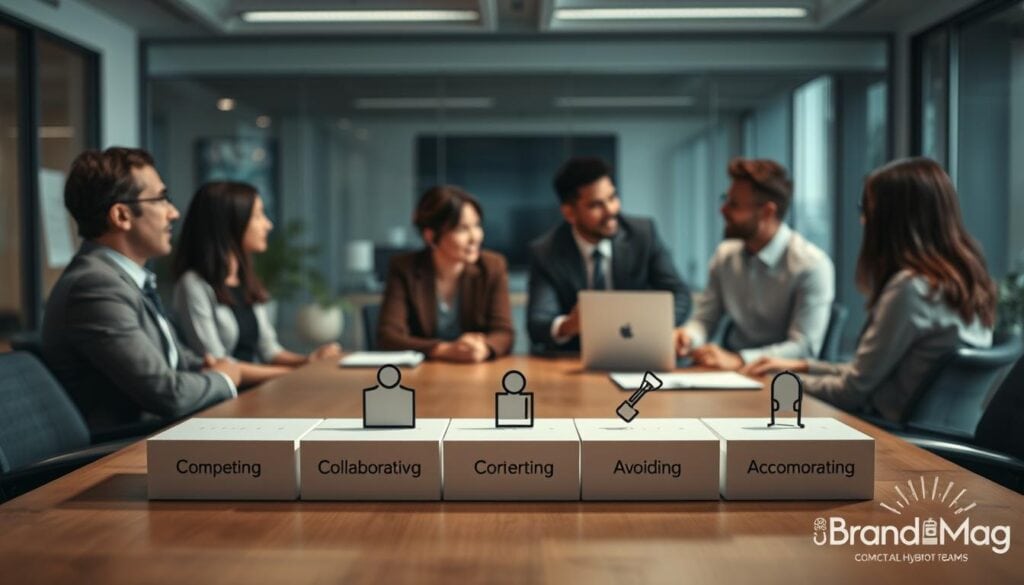
Employing the Thomas-Kilmann Conflict Model for Quick Assessment
The model’s power is its diagnostic speed. You assess the stakes and select the matching strategy. This prevents defaulting to a personal comfort zone that may be ineffective.
Choosing the Right Approach: Avoiding, Competing, Accommodating, Compromising, and Collaborating
Collaborating is our gold standard for most professional disagreements. It’s a win-win where both goals and the relationship matter equally. This strategy generates creative solutions and strengthens team bonds.
Other approaches have specific uses. Competing suits genuine crises. Accommodating can defuse hostility. Compromising works under time pressure but leaves value on the table.
The right choice transforms tension from a liability into a strategic advantage. It ensures you invest energy wisely to resolve conflict constructively.
Key Conflict Resolution Skills for a Collaborative Work Environment
We’ve identified the core competencies that transform workplace tension into productive collaboration. These five skills create the foundation for effective dialogue when disagreements arise.

Developing Active Listening and Assertiveness
Active listening means validating the other person’s perspective before responding. This demonstrates genuine understanding and reduces defensiveness.
Assertiveness balances advocating for your needs with respect for others. It’s the middle ground between passive acceptance and aggressive confrontation.
| Core Skill | Key Action | Impact Level |
|---|---|---|
| Active Listening | Validate before responding | High |
| Assertiveness | Advocate respectfully | Medium-High |
| Composure | Maintain emotional control | High |
| Empathy | Understand others’ perspectives | Medium-High |
| Problem-Solving | Create mutual solutions | High |
Utilizing Empathy and Problem-Solving Techniques
Empathy requires seeing situations through another person’s lens. This skill acknowledges emotional experiences even during disagreement.
Problem-solving transforms interpersonal drama into shared challenges. Both parties work together against the issue rather than against each other.
The three-step process works consistently: Pause to identify triggers, Engage through active listening, and Address by collaborating on solutions.
These capabilities aren’t innate talents. They develop through deliberate practice and real-time application in various situations.
Remote Best Practices: Managing Conflict in Hybrid Teams
Technology choice becomes a strategic decision when managing team friction in distributed environments. The wrong tool can escalate a simple misunderstanding into a major dispute. We design our communication stack with this reality in mind.
Virtual mediation demands explicit process design. You cannot rely on the organic cues of a shared physical space. Every step, from scheduling to documentation, requires intention.
Leveraging Communication Technologies for Virtual Mediation
Not all channels are created equal for serious discussions. Asynchronous text strips away tone and context. This creates fertile ground for misinterpretation.
Video calls are non-negotiable for complex issues. They restore visual cues and allow for immediate clarification. This prevents small problems from festering across time zones.
We establish clear escalation protocols for our teams. These rules define when to move from chat to a live conversation. Training employees to recognize these limits is crucial.
The table below compares channel effectiveness for different stages of a disagreement:
| Communication Channel | Best Use Case | Mediation Suitability |
|---|---|---|
| Email / Project Tools | Documenting agreements | Low |
| Instant Messaging (Slack/Teams) | Initial issue identification | Low-Medium |
| Voice Call | Quick clarification | Medium |
| Video Conference | Full mediation sessions | High |
Structure is your greatest ally in a virtual setting. Open sessions with ground rules. Use structured turn-taking to ensure everyone is heard.
Always document conclusions in a shared space. This creates accountability and a clear reference point. The manager’s role is to facilitate this entire process smoothly.
Leadership and Training Approaches to Mitigate Workplace Conflict
Leadership determines whether team disagreements become constructive dialogues or destructive silences. We position management as the cultural architect of productive friction handling.
Implementing Conflict Resolution Training and Role-Play Scenarios
Training transforms reactive responses into strategic interventions. This investment pays immediate returns through reduced escalations and preserved productivity.
Role-play scenarios build muscle memory for high-pressure conversations. Employees who practice difficult dialogues perform exponentially better when real tension emerges.
We emphasize three core training methods:
- Emotional Intelligence development addresses the root cause of most failures
- Mindfulness techniques regulate emotional responses during disputes
- Feedback mechanisms help employees understand how their interactions are perceived
Establishing Fair Procedures and Clear Policies for Conflict Management
Fair procedures require three components that build employee trust. Culture thrives on predictability, not ad-hoc responses.
The framework includes:
- Legitimate expectations – honoring established practices and promises
- Procedural fairness – impartial, consistent issue resolution by managers
- Distributive fairness – equitable resource allocation across the team
Managers must master neutrality when mediating. Taking sides destroys credibility and ensures the disadvantaged party will never trust your process again.
Companies investing in systematic management training see measurable improvements in retention and team performance within two quarters.
Real-Life Conflict Scenarios and Practical Solutions
We examine real-world disputes to move beyond abstract theory. These cases reveal the messy reality teams face and the specific interventions that create positive outcomes.
Successful managers understand that most friction stems from systemic gaps, not personal failings. They focus on fixing the process, not blaming the people.
Case Study: Resolving Misunderstandings and Work Style Clashes
A classic clash involved a meticulous planner and a spontaneous executor. Tension grew over missed deadlines and perceived rigidity. The manager avoided forcing conformity.
Instead, they facilitated a session where both parties expressed their needs. The solution redesigned the workflow with defined planning phases and creative bursts. Regular progress reviews balanced both styles effectively.
Another situation saw a younger employee’s casual digital communication interpreted as unprofessional by an older colleague. This misunderstanding escalated into a heated exchange.
The supervisor mediated a discussion to establish shared communication standards. This approach avoided declaring one person right. It built common ground for the entire team.
Case Study: Tackling Power Struggles and Discrimination in the Workplace
Consider a long-standing employee, Mike, overlooked for a promotion given to a newer colleague, Sarah. Resentment led Mike to publicly undermine Sarah’s authority. This created a toxic dynamic.
The manager held individual meetings to understand each perspective. They then clarified roles in a team meeting. A mentorship program positioned Mike as a respected senior, sharing knowledge with Sarah. This honored his experience while supporting her new role.
Performance issues require a collaborative frame. When an employee falls short, the goal is to discover the cause together. This maintains the relationship while addressing the business need.
These cases prove that investing time to understand each person’s perspective generates buy-in that top-down mandates never achieve.
However, discrimination or harassment is not a matter for team-level mediation. These serious issues demand immediate HR investigation and policy enforcement.
Conclusion
Transforming workplace challenges into strategic advantages requires more than just theory—it demands systematic action. We’ve equipped you with a complete framework for constructive team dynamics.
The real cost comes from avoidance, not disagreement itself. Your action plan starts with assessment, defaults to collaboration, and builds essential skills.
Modern teams need intentional infrastructure. Video-first mediation and clear protocols prevent digital misunderstandings from escalating.
Leadership creates the culture where employees address issues directly. Training investments deliver measurable returns through stronger cohesion.
Most challenges stem from systemic gaps, not personal failings. This growth mindset reframes tension as learning opportunities.
Your next step: audit current resources against this framework. Identify gaps and implement targeted solutions for your unique work environment.
FAQ
What are the most common triggers for disputes in remote and hybrid teams?
We see the biggest issues stem from communication gaps and mismatched work styles. Without shared physical space, small misunderstandings can escalate quickly. Differing schedules and unclear expectations are also major contributors to team friction.
How can the Thomas-Kilmann model help managers resolve disputes quickly?
This model provides a strategic framework for assessment. It helps leaders choose the right approach—like collaborating or compromising—based on the situation’s urgency and importance. We use it to move from reaction to deliberate action, saving valuable time.
What is the single most important skill for defusing team tensions?
Active listening is non-negotiable. It’s not just about hearing words but understanding the underlying concerns. When employees feel heard, the emotional charge decreases, paving the way for practical problem-solving and a more collaborative environment.
Can technology effectively replace in-person mediation for virtual teams?
A> Absolutely. Video conferencing platforms like Zoom or Microsoft Teams allow for face-to-face conversation, which is critical for reading non-verbal cues. The key is establishing clear ground rules for these virtual meetings to ensure productive dialogue.
Why is formal training in dispute management essential for leadership?
Training transforms how leaders handle issues. Role-play scenarios build muscle memory for difficult conversations. It shifts the culture from avoiding problems to addressing them with confidence and established procedures, which directly impacts employee performance and retention.
How should a manager address a power struggle between two employees?
We recommend a direct, private conversation with each party first to understand their perspectives. Then, facilitate a joint discussion focused on shared goals and responsibilities, not personal grievances. Setting clear boundaries and expectations for future interactions is crucial for a lasting solution.