The landscape of customer engagement has fundamentally shifted. We’re living in a world where 72% of all global internet traffic originates from handheld devices. This isn’t just a statistic—it’s a clear mandate for businesses to adopt mobile-first strategies or risk irrelevance.
Smartphone advertising investment is projected to explode to $228.11 billion globally in 2025. This massive budget allocation signals where savvy professionals are focusing to capture attention and drive measurable returns. The numbers don’t lie—they reveal where the future of customer acquisition is headed.
The commerce revolution has firmly settled in our pockets. With over $3.0 trillion in revenue representing 73% of all online transactions, handheld commerce isn’t an auxiliary channel—it’s the primary battleground. We’ve analyzed campaigns generating billions of views to identify what actually moves the needle.
The stakes couldn’t be higher. Brands that master mobile-first experiences will dominate their markets, while those clinging to desktop-centric approaches will hemorrhage customers to more agile competitors. This comprehensive analysis cuts through the noise to deliver data-backed insights for sustainable growth.
Key Takeaways
- 72% of global internet traffic now comes from mobile devices, making mobile-first strategies essential
- Mobile ad spending will reach $228.11 billion in 2025, indicating where smart budgets are allocated
- Mobile commerce represents 73% of all e-commerce transactions, totaling over $3.0 trillion
- With 4.3 billion mobile users worldwide, the addressable market has never been larger
- Brands mastering mobile experiences will dominate while others lose market share
- Data-backed strategies generate real results rather than following temporary hype
The Mobile-First Revolution
Consumer attention has permanently migrated to handheld screens, creating new engagement paradigms. We’re no longer debating if mobile matters—the question is how to master it.
Mobile Internet Traffic Shift
Desktop usage has become the exception rather than the rule. People now spend over 5 hours daily on their devices. That’s 1,900 hours annually dedicated to a single screen.
This shift isn’t subtle. Americans check their phones 205 times daily—roughly every 5 minutes. The screen in their pocket has become the primary interface for everything.
Consumer Mobile Usage Patterns
Behavioral data reveals critical insights. While users install 40+ apps, they actively engage with only 18. This emphasizes meeting customers where they already are.
“The constant connectivity has rewired consumer expectations. Immediate access isn’t a luxury—it’s the baseline.”
Consider these daily engagement metrics:
| Activity | Frequency | Impact |
|---|---|---|
| Phone checks | 205 times/day | Continuous engagement |
| Screen time | 5.4 hours/day | Extended attention |
| Active apps | 18 regularly used | Platform concentration |
These patterns create unprecedented opportunities. Marketers can reach consumers during their most engaged moments throughout the day.
mobile marketing trends 2025
Strategic planning now demands a fundamental reorientation toward pocket-sized screens. We’re operating in an environment where constrained resources meet heightened expectations for measurable returns.
Defining the Current Landscape
The separation between industry leaders and laggards hinges on one critical decision. Does your approach begin with handheld experiences or attempt to adapt desktop strategies?
Companies treating portable devices as primary touchpoints gain systematic advantages. They achieve higher engagement rates and improved customer lifetime value. This isn’t optional—it’s essential for competitive survival.
Strategic Imperatives for Marketers
Forward-thinking professionals focus on three core pillars. These elements separate effective campaigns from wasted budget allocations.
The market has matured beyond experimental phases. Established frameworks now provide clear performance benchmarks for savvy marketers.
| Strategic Pillar | Key Components | Business Impact |
|---|---|---|
| Content Optimization | Vertical video, quick-loading assets | Higher engagement rates |
| Data-Driven Targeting | Location-based, behavioral insights | Improved conversion metrics |
| Seamless Experience | Intuitive navigation, minimal friction | Increased customer retention |
Key Mobile Marketing Statistics Shaping the Future
Statistical evidence separates successful strategies from wasted resources in modern customer engagement. We analyze hard numbers to guide investment decisions that capture consumer attention effectively.
Record Mobile Ad Spending
The advertising landscape shows clear directional signals. Projected spending of $228.11 billion in 2025 demonstrates where savvy professionals allocate budgets for maximum impact.
This financial commitment reflects calculated risk-taking. Companies follow consumer behavior patterns to achieve superior conversion rates and sustainable growth.
Impact of Mobile Searches
Search behavior data reveals critical insights for strategic planning. With 63% of Google searches originating from handheld devices, optimization priorities become unmistakably clear.
Paid click distribution further validates this shift. Over half of all PPC activity occurs on portable screens, yet many budgets remain misallocated toward outdated assumptions.
| Metric | Current Value | Industry Impact |
|---|---|---|
| Google Search Volume | 63% mobile | SEO strategy essential |
| PPC Click Distribution | 52% mobile | Budget reallocation needed |
| Ad Block Users | 530 million | Content quality critical |
| AR Market Value | $25 billion | Innovation opportunity |
These benchmarks inform our marketing approach. We leverage data-driven insights to optimize campaigns continuously, ensuring every investment generates measurable returns.
Evolving Consumer Behavior and Mobile Engagement
The behavioral gap between generations creates unprecedented targeting opportunities for forward-thinking businesses. We see distinct patterns that demand customized approaches rather than one-size-fits-all strategies.
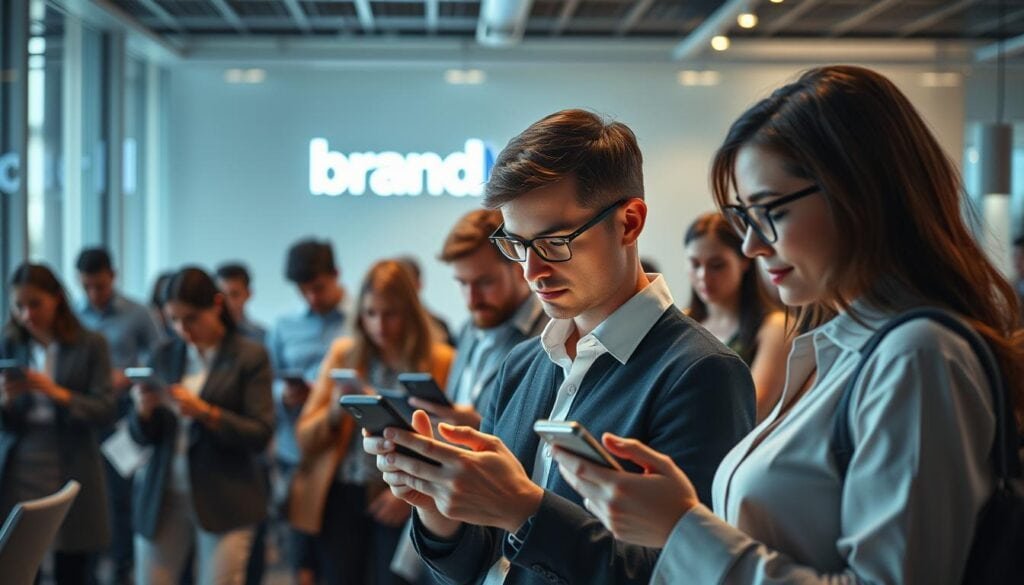
Generational Mobile Habits
Gen Z’s relationship with technology differs fundamentally from older cohorts. 80% use smartphones as their primary device, making traditional multi-screen approaches ineffective. Their preference for short-form video reflects cognitive adaptation to quick, entertaining content formats.
This generation’s buying behavior has transformed commerce. 60% make purchases directly through social platforms, collapsing the traditional sales funnel. Marketers must integrate shopping experiences within entertainment environments.
Millennial engagement reaches near-saturation levels. With 93% smartphone ownership and 72% making monthly purchases via handheld devices, this demographic’s buying power makes optimization essential. Their usage patterns demand seamless, efficient experiences.
Even older demographics show significant adoption. 90% of Gen X and 61% of Boomers own smartphones, though their behavior skews toward essential tasks rather than entertainment. This requires different engagement strategies focused on utility over entertainment.
The in-store search behavior proves handheld devices influence decisions across the entire customer journey. 82% of users search on phones while in physical stores, making integrated approaches critical for modern retail success.
Understanding these generational differences allows precise audience segmentation. Personalized messaging that resonates with each cohort’s unique habits dramatically improves campaign effectiveness and ROI.
Video, Social, and User-Generated Content Strategies
The next frontier for audience connection isn’t a new platform—it’s a fundamental shift in content format and creator. We see a clear move toward snackable video and peer-created media. This evolution demands a strategic pivot from polished broadcasts to authentic, platform-native engagement.
Rise of Short-Form Video
Consumption of video content on handheld devices doubles every year. This 100% growth rate makes it the dominant media format. Brands must adapt or become irrelevant.
Platforms like TikTok, Instagram Reels, and YouTube Shorts rule this space. They demand vertical formats and instant hooks. Success hinges on delivering value within the first three seconds.
YouTube’s data is undeniable: 90% of views happen on portable screens. This proves video is not just compatible; it’s essential. Your content strategy must be built for this reality from the ground up.
Leveraging UGC for Authenticity
User-generated content delivers a level of trust that corporate media cannot fake. It transforms customers into brand advocates. This creates a powerful, authentic community.
Look at Crocs’ #MyCrocsEra campaign. It empowered users to share their stories. The result was a flood of genuine, cost-effective marketing assets.
Strategies centered on UGC consistently achieve higher engagement. Consumers trust recommendations from peers far more than messages from brands. This approach builds credibility and drives organic reach far beyond paid efforts.
Mastering Paid Media and Mobile Advertising Tactics
Paid media represents the most direct path to measurable returns in the handheld-centric landscape. We see a critical disconnect between consumer behavior and budget allocation that creates immediate opportunities for savvy professionals.
Smart investment hinges on aligning spend with actual engagement. While portable screens capture 52% of all PPC clicks, only 19% of U.S. digital budgets target this space. This gap signals a massive competitive advantage for those who reallocate.
PPC and Mobile Ads Effectiveness
Our campaigns consistently prove that platform-specific creative drives superior performance. What works on Facebook fails on TikTok. Resized desktop assets consistently underperform native designs.
Impulse purchase behavior runs 40% higher on these devices. This makes ads particularly effective for products with emotional drivers.
Innovative formats deliver remarkable results. In-game integrations, like McDonald’s partnership with “Honor of Kings,” reach audiences seamlessly. Augmented reality ads show a 37% higher purchase likelihood than traditional banners.
| Advertising Tactic | Key Metric | Strategic Advantage |
|---|---|---|
| Platform-Native Creative | Higher engagement rates | Improved cost-per-acquisition |
| In-Game Integration | Seamless user experience | Captive, engaged audience |
| Augmented Reality Ads | 37% higher conversion | Leverages device capabilities |
Treating handheld screens as the primary canvas transforms campaign ROI. Investment in tailored creative pays for itself through improved metrics at every funnel stage.
Optimizing Mobile Search and App Experiences
Search visibility now hinges on how your content performs on handheld screens, not desktop monitors. Google’s mobile-first indexing means your portable site version determines rankings. This fundamental shift makes optimization essential rather than optional.
Consider the traffic patterns: 61% of Google’s U.S. searches originate from these devices. Strategies built on desktop metrics now optimize for the minority. We must realign our entire approach.
Mobile-First SEO Best Practices
Brand perception directly ties to site quality. 61% of consumers view brands more favorably with excellent portable experiences. Conversely, 57% won’t recommend businesses with poor designs.
Apps deliver superior performance compared to mobile websites. They achieve 3x higher conversion rates with 77% of users preferring them for purchases. This makes development worthwhile for brands with high customer lifetime value.
Notification systems in apps achieve 7x higher response rates than email. They bypass crowded inboxes to reach engaged users directly. This creates a powerful communication channel.
Our essential optimization checklist includes:
- Page speed targeting sub-2-second load times
- Responsive design adapting to various screen sizes
- Content structured for featured snippet dominance
- Clear app versus web strategy based on usage frequency
The decision between app and web depends on interaction patterns. High-frequency engagements justify app development costs. Occasional interactions work better through optimized web experiences without installation friction.
Innovative Mobile Channels: WhatsApp, MMS, and Chatbots
The most overlooked communication channels often deliver the highest returns. While brands pour budgets into saturated social media, smarter strategies leverage direct, private platforms.
These environments create unprecedented intimacy between businesses and consumers. We see engagement metrics that dwarf traditional approaches.
Harnessing WhatsApp’s High Engagement
WhatsApp’s 2.5 billion monthly active users represent an untapped goldmine. Open rates hit 90% with click-through rates reaching 40-70%.
This dwarfs email performance dramatically. It creates a direct line to customers in their most trusted spaces.
Yet most companies ignore this channel entirely. They stick with declining platforms while missing superior engagement.

Dynamic MMS Campaigns
MMS transforms basic text into visual storytelling. Track Optics demonstrated this power during their 2023 holiday campaigns.
Images, GIFs, and videos capture attention where text fails. This creates more engaging customer interactions.
The evolution from broadcast to conversation changes expectations. Two-way dialogue builds relationships beyond simple promotions.
Chatbots powered by conversational AI deliver 24/7 service at scale. They handle routine inquiries while escalating complex issues.
Amazon Alexa shows how voice-activated purchasing removes friction. Similar capabilities will expand across platforms.
Smart marketers add these channels to existing strategies. They reach users in private environments where attention is highest.
Embracing Advanced Technologies: AR, VR, and 5G
We’re entering an era where digital overlays and instant connectivity redefine customer experiences. The infrastructure supporting these innovations separates forward-thinking companies from those stuck in outdated approaches.
The Role of AR/VR in Engagement
Augmented reality has transformed from novelty to necessity. With 1.7 billion users expected by 2025, brands ignoring this technology risk appearing outdated.
The business case is undeniable. Thirty-seven percent of consumers show higher purchase likelihood when brands offer AR experiences. Christian Dior’s lipstick try-on campaign demonstrates practical applications that solve real customer problems.
Furniture retailers using AR for home visualization report 20% conversion increases. This immersive approach reduces purchase uncertainty while boosting sales.
5G Revolutionizing Mobile Media
Fifth-generation network technology enables speeds 100x faster than previous standards. This eliminates loading barriers that once constrained rich media.
High-quality interactive formats become viable with 5G adoption. Brands can now deliver seamless streaming and immersive storytelling that captures attention effectively.
We see AR/VR capabilities converging with 5G infrastructure. This creates a new reality for customer engagement where technology investments translate directly into measurable returns.
Personalization and Hyper-Personalized Mobile Experiences
Artificial intelligence now enables experiences that anticipate individual needs before they’re expressed. We’ve moved beyond basic name recognition to predictive engagement that drives measurable results.
AI-driven approaches analyze behavioral patterns to deliver relevant content precisely when users need it. This sophisticated personalization increases conversion rates by 10-20% through superior relevance.
Consumer expectations have fundamentally shifted. 80% now expect tailored experiences and prefer brands that deliver them, making personalization a competitive requirement rather than an advantage.
Dynamic creative optimization represents the cutting edge of this approach. It automatically adjusts visuals and messaging based on real-time data to maximize relevance for each individual viewer.
Location-based strategies transform devices into bridges between digital and physical commerce. Triggering special offers when users approach stores turns proximity into purchase opportunities.
Apps provide superior personalization capabilities compared to web experiences. They gather richer user data and enable push notifications that deliver personalized content directly.
Privacy considerations balance personalization potential. Transparent data practices and clear value exchanges build trust while enabling the tailored experiences consumers demand.
Data-Driven Mobile Marketing Analytics
The true power of data lies not in collection but in the actionable insights it generates. We’ve moved beyond basic reporting to predictive intelligence that drives measurable business outcomes.
Machine learning algorithms now identify patterns humans miss. They recommend optimizations that drive 30%+ sales increases through precision targeting. This transforms our approach from reactive to proactive.
Leveraging Machine Learning Insights
Real-time processing enables dynamic campaign adjustments that were impossible before. Underperforming ads get paused automatically. Winning variations scale without manual intervention.
AI-generated insights reveal profound consumer behavior trends. They analyze massive datasets across multiple touchpoints. This uncovers hidden segments where targeted messaging delivers outsized returns.
Predictive analytics anticipate user needs before they’re expressed. Marketers deliver solutions at the exact moment intent forms. This captures demand competitors don’t yet recognize.
The competitive advantage compounds over time. More data improves model accuracy. Better predictions increase conversion rates. Higher conversions generate more data in a virtuous cycle.
Sophisticated measurement frameworks track metrics beyond vanity numbers. Focus on customer lifetime value and cohort retention. Connect mobile touchpoints directly to revenue growth.
Social Commerce and Integrated Mobile Shopping
Shopping has transformed from a destination activity to an integrated behavior woven into daily digital interactions. Nearly three-quarters of online sales will occur through handheld devices next year. This shift demands complete rethinking of retail strategies.
Seamless In-App Shopping Experiences
Social platforms now drive 42% of purchases. The traditional sales funnel has collapsed. Brands must integrate commerce directly into entertainment environments.
Zara’s TikTok shop exemplifies this future. Users discover products through engaging content and complete purchases without leaving the app. This removes barriers between inspiration and transaction.
One-click purchasing and AI chatbot assistance eliminate historical friction points. These innovations make handheld buying easier than desktop for many categories.
| Commerce Strategy | Key Feature | Business Impact |
|---|---|---|
| Native Platform Integration | In-app checkout | Reduced cart abandonment |
| Social Discovery | Content-driven shopping | Higher conversion rates |
| Frictionless Experience | One-click purchasing | Improved customer satisfaction |
Successful brands create native shopping experiences that feel like natural extensions of platform behaviors. They recognize this isn’t about replicating e-commerce sites within apps.
Preparing for the Future: Next-Gen Mobile Strategies
We’re witnessing a convergence of technological capabilities that will redefine engagement standards. The landscape is shifting from incremental improvements to fundamental transformations.
Emerging Trends and Innovations
Forty-five percent of users in developed markets now access 5G networks. This critical mass enables experiences previously constrained by bandwidth limitations.
Voice search grew forty-two percent last year, signaling a fundamental behavioral shift. Conversational interfaces demand entirely new content approaches.
Hyper-localization delivers contextually relevant offers that generic campaigns cannot match. Location-specific messaging generates significantly higher engagement rates.
Privacy-first approaches have evolved from compliance requirements to competitive advantages. Transparent data practices build consumer trust that translates to better long-term relationships.
| Current Approach | Next-Gen Strategy | Business Impact |
|---|---|---|
| Broad demographic targeting | Hyper-localized context | Higher conversion rates |
| Text-based search optimization | Voice-optimized content | Improved search visibility |
| Basic privacy compliance | Trust-building transparency | Enhanced customer loyalty |
| Standard connectivity assumptions | 5G-enabled experiences | Competitive differentiation |
Successful organizations allocate seventy percent of resources to proven tactics while dedicating thirty percent to experimental formats. This balanced approach ensures sustainable growth while capturing emerging opportunities.
Conclusion
Execution now separates market leaders from those merely observing industry shifts. The data confirms this reality demands immediate strategic focus.
We’ve demonstrated how attention flows predominantly through handheld screens. Brands that master this environment consistently outperform competitors.
The challenge for most marketers isn’t recognition but implementation. Success requires integrated approaches combining proven tactics with emerging opportunities.
Your next steps should prioritize quick wins that demonstrate impact. Test short-form video where your customers already engage. Optimize high-traffic pages for seamless experiences.
The framework is clear—action creates results. Move beyond understanding to implementation and capture the measurable growth this approach delivers.
FAQ
What is the single most important shift in digital marketing strategy for 2025?
We believe the critical shift is a move from “mobile-friendly” to “mobile-dominant” thinking. Success hinges on designing every campaign, piece of content, and user journey specifically for smartphones first. This requires a deep understanding of how people interact with their devices, prioritizing speed, intuitive design, and high-value interactions over traditional desktop formats.
How can brands effectively leverage user-generated content (UGC) on platforms like TikTok and Instagram?
Authenticity is the currency of UGC. Instead of tightly controlling the message, we advise creating campaigns that invite genuine participation. Launch branded challenges or hashtags that encourage creativity. Feature this content prominently in your ads and on your profile. This strategy builds community trust and generates a powerful, authentic library of promotional material.
Are paid media ads still effective on small phone screens?
Absolutely, but the format is everything. Intrusive banner ads often fail. We see superior performance with native advertising, seamlessly integrated video ads, and shoppable posts within social feeds. The key is providing value within the user’s natural flow, not interrupting it. Platforms like Facebook and Instagram offer highly targeted options that drive measurable ROI.
What role will technologies like Augmented Reality (AR) and 5G play in customer engagement?
These are game-changers for creating immersive experiences. 5G’s speed enables rich, real-time interactions without lag. We use AR for virtual try-ons for products like sunglasses or makeup, interactive manuals, or bringing print ads to life. This transforms passive viewing into an active, memorable brand experience that significantly boosts conversion rates.
Why is personalization beyond using a customer’s first name so critical now?
Basic personalization is table stakes. Hyper-personalization, driven by data and machine learning, is what delivers results. We focus on tailoring entire experiences—recommending products based on past behavior, sending push notifications at optimal times, and customizing content feeds. This level of relevance dramatically increases user engagement and loyalty.
How does social commerce differ from traditional e-commerce?
Social commerce eliminates friction. Traditional e-commerce requires a user to leave an app, go to a website, and navigate a checkout process. With social commerce, the entire journey—from discovery to purchase—happens within the platform, like Instagram Shopping or TikTok Shop. This seamless experience capitalizes on impulse and dramatically reduces cart abandonment rates.