Let’s cut through the noise. The audio landscape is transforming, and brands face a critical question: does spending on this medium deliver real returns? We’re not here to sell you hype—we’re here to deliver hard numbers and strategic insights.
The market tells a compelling story. Audio marketing spending surged to nearly $1.9 billion in 2023 and is projected to smash through the $2 billion barrier this year. This growth isn’t accidental—it’s driven by results.
But here’s what matters: 68% of listeners make purchases based on audio recommendations, and 95% take action after hearing a message. This isn’t about throwing money at another channel; it’s about strategic investment where audiences are genuinely engaged.
We’ll break down the actual pricing models and show you how to calculate true ROI. Forget guesswork—we provide data-backed insights from thousands of campaigns to help you make informed decisions about your 2025 marketing strategy.
Key Takeaways
- The audio marketing market is experiencing explosive growth, surpassing $2 billion in 2024
- Listener engagement drives exceptional results—68% make purchases based on audio content
- Strategic placement and audience targeting determine actual investment value
- Multiple pricing models exist, each with different cost structures and benefits
- ROI calculation requires understanding both direct and indirect returns
- Successful campaigns combine data-driven strategy with authentic audience connection
- 2025 presents significant opportunity for brands that approach this medium strategically
Overview of Podcast Advertising
We’re witnessing a seismic shift in consumer attention that demands new marketing approaches. The audio medium has emerged as a powerful channel for reaching engaged audiences.
This form of marketing integrates paid messages directly into audio content. With over 3.2 million shows covering every niche, there’s relevant space for virtually any business.
The numbers tell a compelling story of growth and opportunity:
| Metric | 2023 Figure | 2024 Projection | Growth Trend |
|---|---|---|---|
| Total Podcasts | 3.0 million | 3.2 million | +6.7% |
| Global Listeners | 464 million | 504.9 million | +8.8% |
| Weekly Consumption | 6.7 hours | 7.1 hours | +6.0% |
Different message formats serve different strategic purposes. Pre-recorded spots offer consistency, while host-read content builds authentic connections.
The true power lies in reaching people during screen-free moments. Commutes, workouts, and household tasks become prime engagement opportunities.
This audio format represents mainstream adoption at scale. Brands across B2B SaaS to consumer products now leverage this channel effectively.
Understanding Podcast Advertising Rates
The question isn’t whether audio marketing works, but how to determine the right investment level for your specific goals. Many brands approach this space with confusion about what constitutes fair pricing.
We see two dominant models governing this landscape. Cost-per-mille (CPM) ties spending directly to download numbers. Flat-rate sponsorships offer fixed fees regardless of audience size.
| Pricing Model | How It Works | Best For | Typical Range |
|---|---|---|---|
| CPM (Cost Per Mille) | Pay per 1,000 downloads | Performance-focused campaigns | $18-$50 per 1,000 |
| Flat-Rate Sponsorship | Fixed fee per episode | Brand awareness plays | $500-$5,000 per spot |
| Hybrid Models | Base fee + performance bonus | Risk-sharing partnerships | Varies by negotiation |
Audience value drives pricing more than raw numbers. A niche show reaching 5,000 decision-makers often commands higher rates than general content with 50,000 casual listeners.
We help advertisers move beyond comparing apples to oranges. The right price point delivers measurable ROI through audience alignment and conversion potential.
This framework lets you assess whether quoted numbers represent genuine value or inflated expectations. Strategic spending requires understanding what you’re buying beyond basic metrics.
The Rise of Podcast Advertising in the United States
The numbers don’t lie: when an industry grows during economic contraction, it’s signaling fundamental shifts in consumer behavior. The U.S. audio content market demonstrated remarkable resilience with 5% growth in 2023, reaching nearly $1.9 billion despite broader marketing sectors facing pressure.
![How does conversion rate influence ACOS on Amazon? [The PPC Den Podcast]](https://www.brandmag.net/wp-content/cache/flying-press/8cb32d3372182fc484657ad92ce578cc.jpg)
We’re seeing accelerating momentum with a projected 12% surge in 2024 pushing total revenue past the $2 billion mark. This isn’t speculative hype—it’s driven by measurable results as companies shift budgets toward channels where people are actually paying attention.
Global audio content consumers are expected to hit 504.9 million by 2024. This represents a massive addressable audience that’s younger, more educated, and more affluent than traditional broadcast demographics.
The rise of this medium in the United States reflects a fundamental shift in media consumption patterns. Smart businesses are capitalizing on this trend before market saturation drives up competition and costs.
Insider Intelligence forecasts spending will grow to $3.53 billion by 2026. This growth trajectory confirms we’re witnessing a permanent reallocation of marketing dollars toward engaged audio audiences.
Benefits of Podcast Advertising
We’ve moved past debating effectiveness to quantifying the unique advantages this medium delivers. The real value lies in measurable benefits that traditional channels struggle to match.
Building Trust and Authentic Connections
The trust factor separates audio content from other marketing channels. Sixty-three percent of listeners find hosts trustworthy. An impressive eighty percent trust their recommendations.
This creates authentic connections that transfer directly to promoted brands. The relationship between audience and host builds lasting brand affinity.
Incremental Reach and Enhanced Engagement
Audio marketing delivers reach that traditional media cannot replicate. It extends radio audience coverage by twelve percent. Television viewer reach increases by fifteen percent.
Attention levels are remarkably high. Sixty percent of people pay attention to messages. Twenty-five percent give their full focus to most content they hear.
For a comprehensive understanding of these advantages, explore our complete guide to audio marketing strategies.
| Benefit Metric | 25-54 Age Group | 18-34 Age Group | Overall Impact |
|---|---|---|---|
| Trust in Host Recommendations | 80% | 82% | High credibility transfer |
| Attention to Messages | 60% | 65% | Superior engagement rates |
| Incremental Reach Beyond TV | 15% | 19% | Expanded audience capture |
| Campaign Effectiveness Boost | 21-40% | 25-45% | Multiplicative results |
These advantages demonstrate why smart brands incorporate audio strategies into their marketing mix. The combination of trust, reach, and engagement creates powerful results.
Key Podcast Advertising Formats and Placements
Format selection separates strategic audio investments from random spending. The choice between message types directly impacts audience reception and campaign effectiveness.
Host-read Sponsorships vs. Pre-recorded Ads
We see two dominant approaches with distinct advantages. Host-delivered messages leverage personal credibility for authentic connections.
These editorialized spots typically run 60 seconds to several minutes. They account for 55% of all audio sponsorship revenue due to their persuasive power.
Pre-produced messages offer consistency across multiple shows. Their 15-30 second format works well for broad reach campaigns requiring controlled messaging.
Placement timing creates different engagement opportunities. Pre-roll positions capture immediate attention at episode start.
Mid-roll spots hit during peak listener focus. Post-roll placements provide budget-friendly options with reduced audience drop-off.
The delivery method affects campaign flexibility. Baked-in ads become permanent content fixtures.
Dynamic insertion enables targeted messaging that adapts to specific listeners. This technical choice impacts both cost structure and audience relevance.
Exploring CPM vs Flat-Rate Sponsorship Models
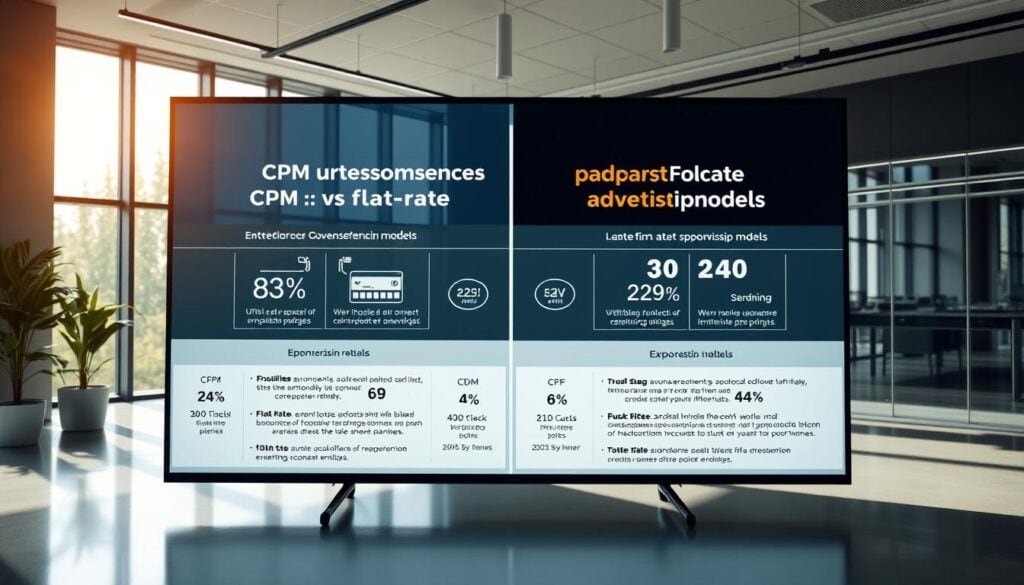
Two distinct financial models govern how brands approach audio content partnerships. We see advertisers consistently navigating between performance-based pricing and fixed-fee structures.
Cost Per Mille Explained
The CPM model ties spending directly to audience reach. You pay a set price for every 1,000 downloads an episode generates within the first 30 days.
Industry-standard CPMs vary by placement. Pre-roll spots typically run $15-$30, while premium mid-roll positions command $25-$50+. Calculate your actual CPM using this simple formula: (Total Ad Cost / Total Downloads) × 1,000.
Understanding Flat-Rate Sponsorship Dynamics
Flat-rate sponsorship offers budget predictability through fixed pricing. This model charges a consistent fee regardless of download numbers.
We find this approach particularly valuable for niche shows with highly targeted audiences. The simplicity appeals to advertisers seeking stable campaign costs without performance fluctuations.
| Model Type | Pricing Structure | Best Application | Risk Profile |
|---|---|---|---|
| Cost Per Mille | Variable based on downloads | Scalable reach campaigns | Performance-dependent |
| Flat-Rate Sponsorship | Fixed fee per placement | Niche audience targeting | Budget-stable |
| Hybrid Approach | Base fee + performance bonus | Balanced partnerships | Risk-sharing |
The optimal choice depends entirely on campaign objectives. CPM delivers transparent performance metrics, while flat-rate offers financial certainty for focused audience engagement.
Factors Influencing Podcast Advertising Costs
We challenge the common assumption that bigger audiences always mean better value. The real drivers of audio marketing costs reflect strategic targeting rather than raw download numbers.
Audience Demographics and Niche Value
Demographic concentration creates pricing disparities that defy simple metrics. A show reaching 10,000 C-suite executives commands premium rates over content with 100,000 casual listeners.
We see advertisers paying 3-5x more for decision-makers with purchasing authority. Industry specificity in fields like fintech or cybersecurity dramatically increases price points.
Professional seniority directly impacts cost structures. Content targeting directors and VPs justifies higher investment due to immediate business needs and budget authority.
Ad Placement and Creative Formats
Placement timing establishes a clear pricing hierarchy. Mid-roll spots capture peak engagement and command the highest CPMs.
Pre-roll positions offer brand awareness at moderate rates. Post-roll placements provide budget-friendly options with acceptable trade-offs.
Creative format significantly affects price. Authentic host-read sponsorships cost more than pre-produced messages due to trust leverage and better response rates.
Industry specificity and purchase intent remain the ultimate cost drivers. Niche audiences actively seeking solutions represent compressed sales funnels where every impression carries higher conversion potential.
Integrating Podcast Advertising with Your Overall Marketing Strategy
Smart businesses recognize that isolated channel performance matters less than combined impact. We see audio content as a force multiplier that amplifies results across your entire marketing mix.
Data proves this multiplier effect. Adding audio content to existing campaigns improves overall effectiveness by 21-40% across most media combinations.
Trust levels jump from 45% to 63% when paired with digital display. The “something new about the brand” metric surges 34% alongside radio campaigns.
| Media Combination | Effectiveness Boost | Trust Increase | Brand Discovery Impact |
|---|---|---|---|
| Audio + Digital Display | 25-35% | 45% → 63% | +28% |
| Audio + Radio | 21-30% | Maintained at 80% | +34% |
| Audio + Social Media | 30-40% | 52% → 68% | +31% |
Track cross-channel attribution carefully. Use unique promo codes and dedicated landing pages to isolate specific contributions.
The winning approach weaves audio content into comprehensive strategies. Each channel reinforces others while building trust foundations that make all touchpoints more effective.
This integration transforms your marketing from separate experiments into a cohesive system. The whole becomes greater than the sum of its parts.
Case Studies and Industry Insights
The evidence speaks for itself: audio content delivers measurable business outcomes. We see consistent patterns across thousands of campaigns that prove this channel’s effectiveness.
Consider the conversion power: 68% of listeners make purchases based on audio recommendations. Even more impressive—95% take some action after hearing a message.
These aren’t vanity metrics. They represent real consumer behavior. Website visits for product information reached 30 million people, up 32% since 2019.
Purchase intent shows even stronger growth. Visits to buy products jumped 44%. Retail location visits for purchases surged 36%.
Direct-to-consumer brands report near-universal success. 98% of DTC marketers confirm this medium effectively reaches their audience.
Our case studies reveal three critical success factors. Authentic host integration builds trust. Clear calls-to-action drive measurable responses. Sustained presence across multiple episodes outperforms one-off placements.
The data proves this channel drives results across the entire buyer journey. From initial awareness to final conversion, the impact is measurable and significant.
ROI and Measuring the Effectiveness of Podcast Ads
We measure what matters, not just what’s easy to track. True campaign effectiveness requires looking beyond basic download numbers to actual business impact.
Establish clear KPIs before launch. Unique promo codes, vanity URLs, and post-purchase surveys provide direct response metrics.
Key Performance Indicators
Track both immediate and lagging indicators. Branded search volume spikes and direct website traffic signal awareness impact.
Promo code usage and attributed sales measure conversion. Social mentions represent “dark funnel” activity traditional attribution misses.
| KPI Type | Tracking Method | Primary Benefit |
|---|---|---|
| Direct Response | Unique promo codes | Clear conversion attribution |
| Awareness Impact | Brand search volume | Measures audience recall |
| Full Funnel | Dedicated landing pages | Captures complete journey |
| Qualitative Impact | Sentiment analysis | Measures brand perception |
Calculating Return on Investment
The basic formula is straightforward: (Revenue – Cost) / Cost × 100. A $5,000 spend generating $15,000 in sales equals 200% ROI.
We push clients beyond simple ROI. Consider Customer Lifetime Value—a single B2B client might generate $500,000+ over years.
Set up proper tracking from day one. UTM parameters and pixel-based attribution to capture the full conversion path.
Creative Strategies for Effective Podcast Ad Campaigns
The most effective audio campaigns leverage the medium’s unique intimacy rather than fighting against it. We’ve found that creative integration beats interruption every time.
Authentic storytelling outperforms polished production. Give hosts creative freedom within your messaging framework—their genuine voice converts better than corporate scripts.
Response rates often double when brands provide product context but let hosts craft the narrative. This leverages the parasocial relationship they’ve built with their audience.
Frame your product as a solution to real problems listeners face. Concrete examples that resonate with the show’s typical audience drive much stronger engagement than feature lists.
Test different creative approaches across episodes. Vary your emphasis, call-to-action, or highlighted benefits. Then optimize based on which unique promo codes generate the most response.
The winning approach embraces this channel’s unique strengths: intimate delivery, extended storytelling time, and credibility transfer from trusted host to brand.
Utilizing Dynamic Ad Insertion for Targeted Reach
The evolution from static to dynamic placement represents the single most significant advancement in audio marketing technology. We’ve moved beyond one-size-fits-all approaches to precision targeting that delivers measurable results.
This technology stitches messages into pre-roll, mid-roll, or post-roll positions based on listener characteristics. Geography, demographics, and listening time all factor into placement decisions.
Advantages of Dynamic Ad Insertion
The system ensures your message reaches only your target audience. This eliminates waste and maximizes campaign efficiency.
Back-catalog monetization becomes possible. Your ads appear in episodes released months or years ago, dramatically expanding reach beyond just new content.
Sophisticated targeting strategies now include conversational matching and IAB episode-level placement. Brands connect with relevant discussions aligned with their products.
| Feature | Dynamic Insertion | Static Placement |
|---|---|---|
| Targeting Precision | Real-time listener matching | Broad audience reach |
| Campaign Flexibility | Mid-campaign adjustments | Fixed from launch |
| Back Catalog Use | Full library monetization | New episodes only |
| Platform Coverage | Cross-app distribution | Limited integration |
The cross-platform advantage is substantial. Once inserted, your messages reach people across Spotify, Apple, Google, Amazon, Audible, and dozens of other apps without separate deals.
This approach enables true A/B testing and optimization. Swap creative mid-campaign and adjust parameters based on real performance data.
Navigating Podcast Advertising in a Competitive Market
Market dynamics are shifting dramatically as more businesses recognize the power of spoken-word content. The landscape is becoming increasingly crowded—and strategic.
We see clear signals that early-mover advantage is closing. Mainstream brands now allocate serious budgets to this channel. The market grew 5% in 2023 to nearly $1.9 billion.
Trends and Forecasts for 2025
A 12% surge in 2024 pushes total revenue past $2 billion. Projections indicate growth to $3.53 billion by 2026. This expansion reflects maturing audience engagement.
Global listeners will reach 504.9 million by 2024. Over 3.2 million shows cover every niche imaginable. Standing out requires quality-focused selection over chasing big names.
Smart brands lock in sponsorships with emerging programs before rates triple. They identify rising content with engaged niche audiences that align with target customers.
The competitive advantage goes to businesses moving beyond one-off placements. Integrated strategies combine paid messages, guest appearances, and original branded content.
Market consolidation and professionalization are underway. Established networks provide better inventory, measurement tools, and performance data than direct deals.
Essential Tips for Budgeting and Campaign Planning
We approach campaign planning with a simple principle: spend where it matters most. Effective budget allocation separates strategic audio investments from wasted spending.
Start with realistic expectations. Self-serve platforms offer entry points around $250, but meaningful reach requires $2,000-$5,000 monthly. Calculate backwards from your goals—100,000 targeted impressions at a $30 CPM equals $3,000 spend.
Allocate 60-70% of your budget to mid-roll placements. Despite higher CPMs ($25-$50+), engagement and conversion rates justify the premium over cheaper pre-roll and post-roll positions.
Plan for sustained presence across 8-12 weeks. Listeners need 3-7 exposures before taking action. Consistent weekly presence outperforms short-term blitzes.
Build 15-20% contingency for testing different shows and creative approaches. Then reallocate toward highest-performing placements.
Track cost-per-acquisition alongside CPM. A $50 CPM show delivering $30 CPA beats a $20 CPM show with $80 CPA every time.
Set success metrics tied to business outcomes—leads generated, sales closed, CAC reduction. This definitive approach answers whether your podcast advertising cost delivered real ROI.
Innovative Tactics for Leveraging Podcast Advertising
We’re seeing a fundamental shift in how successful companies approach audio content—moving from transactional placements to strategic partnerships. The most effective strategies now blend multiple approaches rather than relying on any single tactic.
Maximizing Unique Promotions with Guesting & Branded Content
Guest appearances deliver instant authority by leveraging host credibility. You gain 30-60 minutes to demonstrate expertise rather than 60 seconds for a pitch. This approach builds deeper connections with targeted audiences.
Content repurposing multiplies your investment exponentially. Transform one episode into social media clips, newsletter insights, and blog posts. This extends your reach across every marketing channel.
Branded content represents the premium tier of integration. Your product or expertise becomes woven into the editorial fabric rather than inserted as traditional ads. This creates authentic engagement that drives meaningful results.
Track guest appearance ROI through unique URLs and direct listener outreach. These “dark funnel” activities often generate more qualified leads than conventional campaigns. The combined approach delivers comprehensive audience engagement.
Conclusion
The final verdict isn’t about price tags—it’s about strategic positioning. We’ve shown that the real question shifts from cost to measurable value and return.
The data speaks loudly. A 68% purchase rate based on audio recommendations proves this channel’s power. Adding this medium to your mix boosts overall campaign effectiveness significantly.
Your path forward is clear. Start with targeted tests on niche shows. Build a framework to track real ROI from the beginning.
This audio medium delivers one of the highest returns for brands targeting engaged, decision-making audiences. The winning move is to invest where trust and action converge.
FAQ
What is the average cost for a podcast sponsorship?
The price varies significantly based on audience size and niche. We see CPMs ranging from to for mid-tier shows, while premium programs can command much higher flat-rate sponsorships. The final cost depends on your campaign’s specific goals and the show’s listener engagement.
How do I measure the success of my campaign?
We track performance using several key metrics. Beyond simple download numbers, we focus on conversion rates, unique promo code usage, and direct website traffic attributed to the audio content. The true measure is the sales lift and brand awareness generated.
Are host-read ads more effective than pre-produced spots?
Typically, yes. Host-read sponsorships build greater trust and authenticity, which often leads to higher listener engagement and conversion. The host’s genuine endorsement carries more weight than a standard pre-roll or mid-roll ad, making it a premium format for many brands.
What is the difference between CPM and a flat-rate sponsorship?
CPM (cost per mille) means you pay for every thousand downloads, offering scalability. A flat-rate sponsorship is a fixed price for an ad slot, regardless of final download numbers. We often recommend flat rates for predictable budgeting on established shows with stable audiences.
How can I ensure my ad reaches the right people?
Careful selection is key. We analyze a show’s audience demographics, content niche, and listener loyalty to ensure alignment with your target market. Utilizing dynamic ad insertion technology also allows for more precise geographic and behavioral targeting within a podcast’s audience.
Is this medium suitable for building brand awareness?
Absolutely. Podcasts offer a unique combination of engaged attention and trusted voices. This environment is ideal for introducing your product or service to a captive audience, making it a powerful tool for increasing reach and enhancing long-term brand recognition.