The audio audience is growing, and marketers are asking a simple question: will podcast ads actually move the needle for my brand? This guide gives clear pricing context and the basic math you need to estimate ROI, not marketing hype.
One verified benchmark: podcast ad spend in the U.S. reached about $1.9 billion in 2023, with industry forecasts projecting more than $2 billion for 2024 (Insider Intelligence, 2024). Source: https://www.insiderintelligence.com/
Survey-based metrics are often cited to show strong listener response; for example, some industry surveys report high intent and action rates after audio exposure—treat these numbers as indicative but variable by show and audience. Use them to inform testing rather than to guarantee results.
This article breaks down the common pricing models, how to calculate a working CPM, and the practical steps to estimate whether your first campaign is worth the investment.
Quick action item: use a CPM formula ((Total Cost / Downloads) × 1,000) with a small test budget to validate assumptions — or try this simple ROI calculator to estimate outcomes before you buy.
Overview of Podcast Advertising
Podcast advertising places paid messages directly inside audio shows to reach people in moments when they are often undistracted—commutes, workouts, and household tasks. As a medium, it now reaches mass and niche audiences alike, making it useful for both broad brand awareness and tightly targeted performance campaigns.
Industry scale: the podcast ecosystem exceeded 3.0 million shows and is estimated to be above 3.2 million in 2024, while global podcast listeners are projected to surpass 500 million (Podcast Index / Edison Research estimates). Treat these figures as market context for planning rather than guarantees of reach for any specific show.
The core advantage is relevance: shows cover every niche, so advertisers can find audiences that match customer profiles rather than relying on blunt-reach buys.
| Metric 2023 | Figure 2024 | Projection | Growth Trend | |||
| Total Podcasts | 3.0 million | 3.2 million | +6.7% |
| Global Listeners | 464 million | 504.9 million | +8.8% |
| Weekly Consumption | 6.7 hours | 7.1 hours | +6.0% |
Different message formats serve different goals: short pre-recorded ads give controlled branding; longer host-read spots create *trust* because they come from a familiar voice.
Understanding Podcast Advertising Rates
Two main pricing structures dominate podcast advertising: CPM (cost per mille) and flat-rate sponsorships. Use the right model for your objective—performance or predictable brand presence.
| Pricing Model | How It Works | Best For | Typical Range | |||
| CPM (Cost Per Mille) | Pay per 1,000 downloads | Performance-focused campaigns | $18-$50 per 1,000 |
| Flat-Rate Sponsorship | Fixed fee per episode | Brand awareness plays | $500-$5,000 per spot |
| Hybrid Models | Base fee + performance bonus | Risk-sharing partnerships | Varies by negotiation |
Two quick examples to apply these ranges:
- Performance test: a $30 CPM mid-roll buy on an episode with 100,000 downloads costs roughly $3,000 and can be used to measure direct response via promo codes or landing pages.
- Brand awareness: a $1,500 flat-rate sponsorship on a tight niche show gives predictable placement and creative control for a product launch aimed at that audience.
Practical tip: calculate CPM with this formula — (Total Ad Cost / Downloads) × 1,000 — and always pair buys with unique promo codes or UTM-tagged landing pages to measure results.
The Rise of Podcast Advertising in the United States
Podcast advertising has moved from niche experiment to mainstream marketing line item. In the U.S., ad spending grew roughly 5% in 2023 to about $1.9 billion, and industry forecasts project continued expansion into the $2+ billion range for 2024 (Insider Intelligence, 2024). Source: https://www.insiderintelligence.com/
These revenue trends reflect shifts in where listeners spend time: global podcast audiences are projected to top 500 million, and the medium skews younger and more affluent than many legacy channels—use those demographics to target audiences rather than assume uniform response across shows.
Note: much of the audience and trust data below come from survey research and platform reports; treat percentages as directional indicators that vary by show, category, and geography.
We’re seeing measurable momentum as advertisers reallocate budgets toward audio because people often listen during undistracted moments and exhibit high engagement with host messaging. Still, expect variability: measurement lag, undercounted multi-touch attribution, and differing survey methodologies can produce wide ranges in reported lift.
Benefits of Podcast Advertising
Podcast ads deliver three practical advantages for marketers: trust transfer from hosts, incremental reach that complements other media, and high listener attention during episodes.
Building Trust and Authentic Connections
Host endorsements create credibility transfer that many advertisers can’t replicate in other formats. Survey figures commonly cited show high trust levels for hosts (survey results vary by source), which explains why host-read ads often produce stronger response rates than generic spots—though they cost more and may not scale as easily across many shows.
Incremental Reach and Enhanced Engagement
Audio can expand reach beyond radio and TV in specific audience segments. For example, podcast audiences add incremental reach among 25–54 and 18–34 cohorts in many markets, and attention metrics tend to be higher because listeners are engaged in an audio-first context. Again, those percentages vary by study and should be validated for your target shows.
For further reading on strategies and platform-level guidance, see this industry guide: Acast: Podcast advertising guide.
| Benefit Metric | 25-54 Age Group | 18-34 Age Group | Overall Impact | |||
| Trust in Host Recommendations | ~80% (survey-dependent) | ~82% (survey-dependent) | High credibility transfer; varies by show |
| Attention to Messages | ~60% | ~65% | Higher than many display channels |
| Incremental Reach Beyond TV | ~15% | ~19% | Useful for filling audience gaps |
| Campaign Effectiveness Boost | 21–40% | 25–45% | Ranges from modest to substantial depending on mix |
How to use these benefits: target shows where the host audience matches buyer personas, expect to pay a premium for high-trust placements, and plan measurement that captures both direct response (promo codes, UTMs) and longer-term brand lift (search spikes, organic traffic growth).
Key Podcast Advertising Formats and Placements
Choosing the right format and placement separates effective podcast ads from wasted spend. Match message length, voice, and timing to the listener’s mindset for the best results.
Host-read Sponsorships vs. Pre-recorded Ads
Host-read sponsorships tap into trust built between the host and their audience. These spots (often 30–60 seconds, sometimes longer) tend to drive stronger immediate response but usually cost more and can be harder to scale across many shows.
Pre-produced ads (15–30 seconds) deliver consistent branding and are easier to run programmatically; they perform best when you need repeatable creative across many episodes, but they typically generate lower trust and lower lift than authentic host reads.
Fact: industry reports indicate host-read formats account for a large share of sponsorship revenue in many markets—treat that as a signal that advertisers pay a premium for authenticity (source: IAB / industry rate reports).
Weaknesses to acknowledge: host reads cost more per impression and may not be available at scale; baked-in placements are hard to change after publication; pre-produced ads can feel interruptive if poorly timed.
Placement timing matters:
- Pre-roll — captures initial attention but can suffer from audience drop-off; typically lower CPMs.
- Mid-roll — hits during peak attention and usually delivers the best conversion rates; commands the highest CPMs.
- Post-roll — cost-effective for finishing touches but reaches a smaller, more committed audience.
Delivery options:
- Baked-in ads are edited into the episode permanently — good for integrated storytelling but inflexible for updates or targeting.
- Dynamic ad insertion (DAI) allows ads to be swapped in real time based on geography, episode, or listener attributes — useful for targeted buys and back-catalog monetization.
Exploring CPM vs Flat-Rate Sponsorship Models
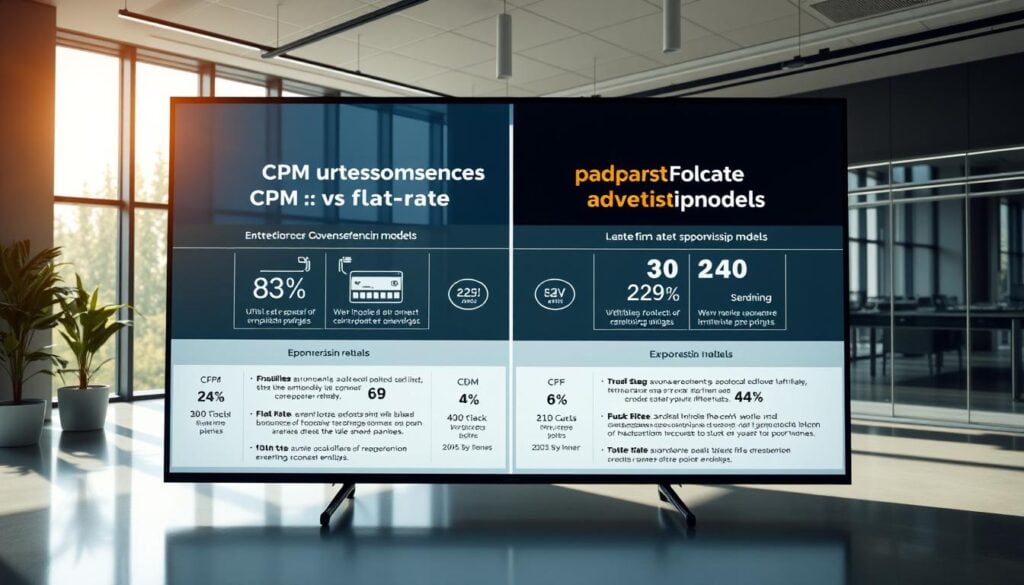
Two financial models dominate podcast ads: CPM (cost per thousand downloads) and flat-rate sponsorships. Each has a clear winner depending on your goal:
- Winner for performance/measurement: CPM. It ties cost to downloads and lets you benchmark CPM and CPA precisely.
- Winner for predictable budgeting and niche targeting: Flat-rate. It provides stable pricing and is often preferred for tightly focused shows.
Cost Per Mille Explained
CPM pricing means you pay per 1,000 downloads. Use this formula to calculate: (Total Ad Cost / Total Downloads) × 1,000.
Typical market ranges (by placement): pre-roll $15–$30 CPM; mid-roll $25–$50+ CPM. Example calculation: a $3,000 mid-roll buy on an episode with 100,000 downloads → (3,000 / 100,000) × 1,000 = $30 CPM.
Understanding Flat-Rate Sponsorship Dynamics
Flat-rate deals charge a fixed fee per episode regardless of final downloads. They’re attractive when you need budget certainty or when a niche show’s audience closely matches your buyer persona.
| Model Type | Pricing Structure | Best Application | Risk Profile | |||
| Cost Per Mille | Variable based on downloads | Scalable reach campaigns | Performance-dependent |
| Flat-Rate Sponsorship | Fixed fee per placement | Niche audience targeting | Budget-stable |
| Hybrid Approach | Base fee + performance bonus | Balanced partnerships | Risk-sharing |
Practical tip: run a small CPM test to measure CPA or promo-code performance; if the match is strong and CPA is acceptable, scale—otherwise, consider flat-rate buys on other niche shows.
CTA: use a quick CPM calculator (Total Cost ÷ Downloads × 1,000) and pair the result with a tracked landing page or unique promo code to measure real campaign outcomes.
Factors Influencing Podcast Advertising Costs
Bigger download counts don’t automatically mean better value. The true determinants of podcast ad pricing are audience fit, ad placement, and creative format—factors that affect conversion potential more than raw reach.
Audience Demographics and Niche Value
Not all audiences are equal. Shows that reach high-intent or high-income listeners—C-suite executives, industry specialists, or buyers in vertical categories—command premiums because each impression has higher conversion potential. Advertisers commonly pay multiples for these tightly targeted audiences compared with mass-reach shows.
Example: a niche fintech show that reaches 10,000 decision-makers can justify a much higher CPM than a general-interest show with 100,000 casual listeners because the purchase intent and buyer authority compress the funnel.
Practical check: always request audience demos and advertiser references for niche shows, and compare listener job titles, buying authority, and topical relevance before agreeing to rates.
Ad Placement and Creative Formats
Placement timing and creative style create a clear pricing ladder:
- Mid-roll = highest CPM and usually the strongest conversion because it hits during peak engagement.
- Pre-roll = moderate CPM, good for awareness but more likely to be skipped or ignored.
- Post-roll = lowest price point but reaches the most loyal portion of the audience who listen to the end.
Creative format matters too. Host-read sponsorships typically cost more because the host’s endorsement transfers trust; pre-produced ads cost less but often deliver lower lift. Baked-in ads are permanent and harder to update, while dynamic insertion allows targeting and swaps but can feel less integrated.
Weakness to acknowledge: host-read spots can be expensive and limited in scale; dynamic ads reduce permanence and can slightly lower perceived authenticity.
Integrating Podcast Advertising with Your Overall Marketing Strategy
Podcast ads perform best as part of a coordinated marketing system rather than as a standalone experiment. Research and cross-channel reporting show audio amplifies results when paired with other channels—use podcast buys to raise awareness and drive targeted response through tracked assets.
One realistic omnichannel setup:
- Audio: 8–12 weeks of mid-roll host-read spots on 3 niche shows matched to buyer personas.
- Digital: UTM-tagged landing pages and paid search retargeting for listeners who visit the site.
- Email & Social: follow-up nurture sequences and short social clips repurposed from the episode.
Expected KPIs to track: promo-code redemptions (direct response), branded search volume (awareness lift), and CPA (cost per acquisition) across channels. Use UTMs, unique promo codes, and a dedicated landing page to isolate audio-driven traffic.
Attribution caution: podcast-driven conversions often appear in the “dark funnel.” Expect lagged purchases and multi-touch journeys—measure both immediate conversions and longer-term signals (search spikes, organic traffic, and assisted conversions).
CTA: before buying, run a 4–6 week pilot with clear KPIs, allocate 10–20% contingency for testing shows and creative, and follow this checklist: UTMs set, promo codes ready, landing page live, and tracking in place.
Case Studies and Industry Insights
Public case studies and industry reports show predictable patterns: authentic integration, clear calls-to-action, and sustained presence outperform one-off placements. Instead of vague claims, look for published examples with measurable KPIs you can compare to your own goals.
Verifiable example: a public campaign reported by a DTC brand increased site visits and conversions after an 8-week host-read series (see brand case study or network report for details). Use these published cases as benchmarks, but adjust expectations to your product, price point, and funnel.
Three consistent success factors emerge from documented case studies:
- Authentic host integration — the host weaves the product into relevant conversation.
- Clear, trackable calls-to-action — promo codes or vanity URLs tied to the episode.
- Sustained flighting — multiple episodes over several weeks rather than one-off spots.
ROI and Measuring the Effectiveness of Podcast Ads
Measuring what matters requires combining direct response and brand metrics. Don’t rely solely on downloads—pair them with tracked landing pages, promo codes, and search trends to capture the full impact.
Key Performance Indicators
Track immediate and lagging indicators to understand both short-term conversion and longer-term brand lift:
| KPI Type | Tracking Method | Primary Benefit | ||
| Direct Response | Unique promo codes | Clear conversion attribution |
| Awareness Impact | Brand search volume / organic traffic | Measures audience recall and discovery |
| Full Funnel | Dedicated landing pages with UTMs | Captures the complete journey from listen to purchase |
| Qualitative Impact | Post-listen surveys & sentiment analysis | Measures perception and message resonance |
Calculating Return on Investment
Use a simple ROI formula for direct buys: (Revenue − Cost) / Cost × 100. Example: a $5,000 spend that generates $15,000 in tracked sales = 200% ROI.
Worked example with downloads and CPA: if a campaign costs $3,000 and the episode records 100,000 downloads, CPM = (3,000 / 100,000) × 1,000 = $30. If promo codes show 100 purchases at $75 average order value, revenue = $7,500 and CPA = $30; ROI = (7,500 − 3,000) / 3,000 × 100 = 150%.
Attribution windows and dark-funnel effects: many podcast-driven purchases appear days or weeks later. Use a 14–30 day attribution window for promo-code conversions and monitor branded search and assisted conversions for 60–90 days to capture longer-term impact.
Limitations: promo codes undercount multi-touch paths and baked-in ads can’t be updated, so complement direct metrics with brand-lift studies or uplift in organic traffic.
CTA: before scaling, run a 4–8 week pilot with UTMs, a unique promo code, and a dedicated landing page. Track downloads, landing page conversions, promo-code redemptions, and branded search volume to determine whether to expand the buy.
Creative Strategies for Effective Podcast Ad Campaigns
The most effective podcast ads use the medium’s intimacy to tell a relevant story rather than interrupting. Focus on message fit and host alignment to turn listener attention into action.
Authentic storytelling typically outperforms overly produced reads. Give the host a concise brief and the freedom to use their voice—their recommendation will feel natural and *trustworthy* to the audience.
Concrete framing works best: present your product as a solution to a specific listener problem rather than reciting features. Use a clear call-to-action tied to a tracked landing page or promo code so you can measure direct response.
Test creative systematically across episodes: vary CTAs, offer structure, and message length, then optimize based on which unique promo codes and landing-page conversions perform best.
30s and 60s Script Templates
Host-read (30s): “I’ve been trying [product] — it helped me [specific benefit]. If you want to try it, go to yourbrand.com/podcast for 15% off — that’s yourbrand.com/podcast.”
Produced (60s): “This episode is brought to you by YourBrand. [Brief problem statement]. For a limited time, visit yourbrand.com/podcast to learn more and get 15% off. Offer ends MM/DD.”
Utilizing Dynamic Ad Insertion for Targeted Reach
Dynamic ad insertion (DAI) enables you to place different messages into the same episode depending on listener attributes such as geography or device. Leading ad platforms (e.g., AdsWizz, Megaphone, Spotify Ad Studio) support cross-app DAI, allowing targeted delivery across major podcast players (source: platform docs).
Advantages of Dynamic Ad Insertion
- Targeting precision: reach listeners by region, device, or episode-level context.
- Back-catalog monetization: ads can run in older episodes to extend reach beyond new releases.
- Mid-campaign optimization: swap creatives or offers based on early performance.
Note the trade-offs: DAI provides precision and flexibility but can feel less integrated than baked-in host reads. Use DAI for performance-focused buys and reserve host reads for credibility-driven messaging.
A/B Testing Checklist
- Define hypothesis (e.g., “Host-read with promo code A outperforms produced ad with promo code B”).
- Run both creatives across similar episodes or matched audiences.
- Track metrics: landing-page conversions, promo-code redemptions, and branded search lift.
- Use a 2–4 week test window and keep creative consistent except for the single variable you’re testing.
Practical metric examples: measure CTR to your landing page, promo-code usage, and CPA. Combine short-term direct-response metrics with longer-term signals like branded search and assisted conversions to judge overall effectiveness.
Navigating Podcast Advertising in a Competitive Market
Podcasting has shifted from an experimental channel to a crowded marketplace. As more brands buy podcast ads, the advantage moves to advertisers who pick quality alignment over headline reach and plan for multi-episode runs.
Verified trend: Insider Intelligence projects continued growth in podcast ad spend, supporting the view that budgets are reallocating to audio (Insider Intelligence, 2024). Source: https://www.insiderintelligence.com/
Trends and Forecasts for 2025
Expect upward pressure on rates as demand rises and inventory professionalizes. Forecasts show the market expanding past $2 billion in 2024 with further growth toward mid-single-digit billions by 2026; use these projections to set timing for pilot buys rather than as guarantees of ROI.
Practical implication: don’t chase the biggest shows by vanity downloads alone. Emerging niche programs often deliver better cost-per-acquisition when their audiences match your buyer personas.
Market structure is changing: established networks now offer programmatic and measurement tools that individual shows rarely provide, which can simplify targeting and reporting but may come with higher minimum spends.
Essential Tips for Budgeting and Campaign Planning
Start with a realistic pilot budget and clear objectives. Self-serve platforms allow very small tests (often around $250 entry), but meaningful performance tests typically begin in the $2,000–$5,000 per month range when you want reliable signal.
Rule of thumb allocation and rationale:
- Allocate 60–70% of the media budget to mid-roll placements — they hit during peak engagement and usually justify higher CPMs with better conversion.
- Reserve 15–25% for pre-roll and post-roll tests and programmatic buys to broaden reach and compare formats.
- Hold 10–20% contingency for creative tests, additional shows, or doubling down on top performers.
Sample 3-month budget (example):
- Media buys: $9,000 (mid-roll heavy across 3 niche shows)
- Creative and production: $1,500 (host-read briefing, short produced spot)
- Tracking and landing pages: $500 (UTMs, analytics)
- Contingency/testing: $1,000
Example CPM → impressions → cost math: 100,000 impressions at a $30 CPM = $3,000. If that campaign generates a $30 CPA, and lifetime value supports the spend, scale; if CPA is too high, change shows, creative, or placement.
Exposure planning: plan for 8–12 weeks and expect listeners to require multiple exposures (commonly 3–7) before acting — treat this as a marketing heuristic to design flighting rather than a precise rule.
Measurement focus: track CPA alongside CPM. A higher CPM mid-roll that yields a lower CPA is a better buy than a low-CPM placement that produces weak conversions.
Practical CTA: start with A/B tests across 2–3 matched shows, use unique promo codes and UTMs, and run a minimum 4–8 week pilot to collect reliable conversion data before scaling.
Innovative Tactics for Leveraging Podcast Advertising
Top advertisers now use a mix of paid placements, guest appearances, and branded content rather than relying on single-episode buys. That blended approach increases reach and improves message resonance across different listener touchpoints.
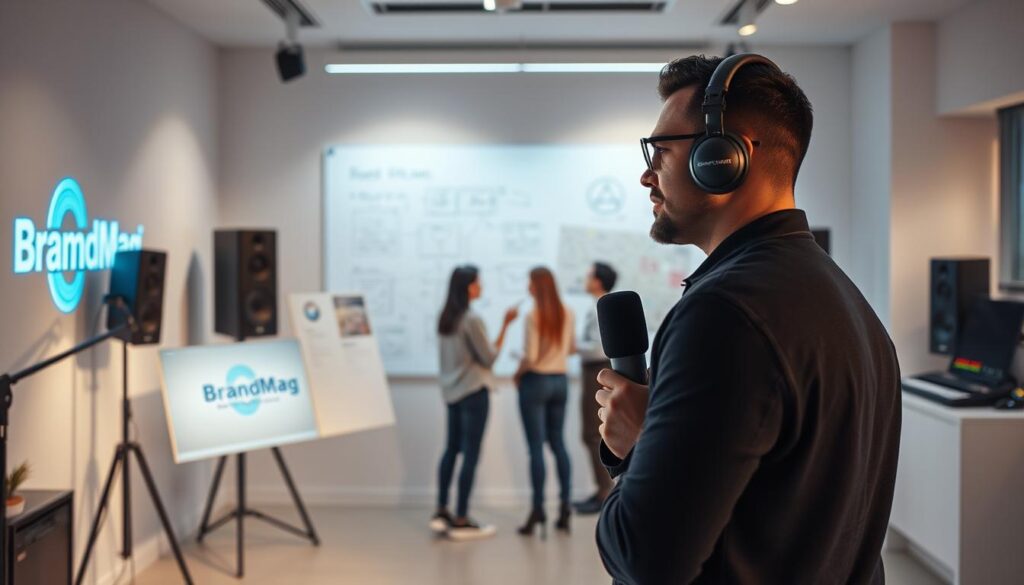
Maximizing Unique Promotions with Guesting & Branded Content
Guest appearances give you longer-form time to demonstrate expertise and build authority—often 20–60 minutes depending on the show format—so they can drive deeper engagement than a short ad. Use a guest slot to explain real use cases, answer audience questions, and end with a clear, trackable call-to-action.
Branded content—episodes or segments produced with the brand integrated into the editorial—delivers sustained exposure and often higher attention because it feels native to the show. Note the trade-off: branded content costs more and requires closer editorial collaboration with the host or network.
Repurpose one appearance into social clips, blog posts, email content, and paid social ads to amplify the investment across channels and improve measured reach and conversions.
Verifiable point: several platform and network case studies show guest appearances can lift branded search and site visits within weeks of airing—use published case studies from networks or companies as benchmarks for your campaign planning (see network case studies for specific figures).
Tracking tip: use a unique promo code + dedicated landing page for each guest appearance so you can attribute direct sales and also monitor branded search and organic traffic for broader lift.
Conclusion
Podcast advertising isn’t a single, one-size-fits-all buy—it’s a strategic toolbox. Start with small, tracked tests on niche shows and scale the formats (host-read, DAI, guesting) that produce the best CPA and brand signals for your product.
Action to take next: run a focused 4–8 week pilot with UTMs, a unique promo code, and a tracked landing page to decide whether to expand.
Recommendation: use a mix of host-read mid-rolls for credibility and targeted DAI buys for scale; prioritize shows whose audiences match your buyer personas.