

Let’s be direct: most teams are drowning in complexity. They manage dozens of platforms, shifting metrics, and constant stakeholder demands. Traditional plans simply can’t keep pace.
Many groups believe they’ve adopted this approach by renaming meetings or using new software. These surface-level changes rarely deliver meaningful results. We hear it often: “We tried it, but it didn’t work.”
This isn’t about applying a generic framework to your work. It’s a complete operating system built for the creative, cross-functional chaos your group faces daily. This guide serves as your practical compass.
We’ll show you the strategic framework and evidence-based practices that transform groups from reactive order-takers into proactive, influential business drivers. You’ll learn to focus on customer value over sheer output.
This methodology is especially vital now. With unprecedented data and uncertainty, adaptive planning and transparency are essential survival skills for any modern team.
Key Takeaways
- Agile marketing is a purpose-built system, not just a renamed process.
- Traditional planning methods fail in today’s complex, multi-channel environment.
- True transformation requires more than just cosmetic changes like new tools.
- The focus shifts from campaign volume to delivering measurable customer value.
- This approach builds proactive, influential teams that drive business results.
- Adaptive planning is essential for navigating data-rich, uncertain markets.
Understanding the Agile Marketing Landscape
Marketing complexity has reached a tipping point that demands new approaches. We’ve moved beyond simple channel management into orchestrating entire digital ecosystems.
What is Agile Marketing?
This framework represents a fundamental shift in planning philosophy. Instead of rigid annual campaigns, teams operate in short, focused cycles.
These sprints typically last two weeks. They allow for rapid testing and adaptation based on real customer feedback.
Modern Marketing Challenges
Today’s environment presents unprecedented obstacles. Customer journeys span countless touchpoints across multiple platforms.
Attribution complexity and constant algorithm changes create constant pressure. Teams must demonstrate ROI on every initiative.
The table below highlights why traditional methods struggle in this landscape:
| Traditional Approach | Agile Approach | Key Difference |
|---|---|---|
| Quarterly campaign cycles | Two-week sprints | Speed of adaptation |
| Fixed annual plans | Flexible priorities | Responsiveness to change |
| Delayed launch feedback | Continuous customer input | Real-time optimization |
| Volume-focused output | Value-driven results | Business impact focus |
This methodology breaks large initiatives into manageable components. It enables course correction when strategies underperform.
Mastering Agile Marketing Methodology
The 2012 Agile Marketing Manifesto provides the strategic framework that redefines how modern teams operate. This isn’t another project management system—it’s a purpose-built approach for marketing’s unique challenges.

Key Components and Principles
Ten core principles guide effective implementation. They focus on satisfying customers through continuous delivery and embracing diverse perspectives.
Teams respond to change to enhance customer value. They plan only enough for effective prioritization and learn from failures through experimentation.
The methodology emphasizes small, cross-functional teams and building programs around motivated individuals. Sustainable pacing prevents burnout while maintaining marketing fundamentals.
| Traditional Mindset | Agile Principle | Strategic Advantage |
|---|---|---|
| Rigid annual planning | Adaptive prioritization | Market responsiveness |
| Departmental silos | Cross-functional collaboration | Integrated execution |
| Volume-focused output | Value-driven delivery | Measurable impact |
| Fear of failure | Experimental learning | Continuous improvement |
Benefits for Marketing Teams
This approach delivers substantial benefits for marketing teams. Greater efficiency allows doing more with existing resources.
Teams demonstrate impact through continuous delivery. Workloads become predictable, reducing last-minute chaos.
Morale improves as team members see direct results. They operate at sustainable pace rather than constant firefighting mode.
Customers receive value in frequent increments. Teams respond quickly to feedback and continuously improve experiences.
The Evolution: From Traditional Methods to Agile Strategies
The shift to agile strategies didn’t originate in marketing departments. It emerged from software development’s crisis in the 1990s. Traditional waterfall project management was failing spectacularly.
A 1995 report revealed only 16.2% of software projects completed on time and budget. Large enterprises saw just 9% success rates. Another study of $37 billion in Defense Department projects found 46% of systems never got successfully used.
Historical Shifts in Marketing
Software developers faced the same challenge marketers face today. They were too far removed from end users. Requirements documents passed through multiple management layers created products that met specifications but failed customer needs.
In February 2001, seventeen software practitioners wrote the original Agile Manifesto. This transformed how knowledge work gets done across industries. Teams achieved transparency and predictable delivery.
The results were staggering. Development teams delivered work in small increments instead of years-long projects. They maintained predictable costs and adapted quickly to market changes.
| Traditional Marketing | Modern Approach | Critical Difference |
|---|---|---|
| Annual campaign cycles | Weekly adaptations | Response speed |
| Fixed channel strategies | Multi-platform integration | Flexibility |
| Delayed performance data | Real-time optimization | Decision timing |
| Volume-focused output | Value-driven results | Business impact |
Adapting to the Digital Age
Marketing began adopting these principles later. The Agile Marketing Manifesto arrived in 2012. Teams recognized similar challenges of rapid change and customer-centricity requirements.
The digital age accelerated this need. The internet, social media, and mobile devices created environments where monthly campaigns became obsolete. Groups must adapt weekly or even daily to remain competitive.
Traditional planning worked when channels were limited. Today’s fragmented landscape demands the flexibility that only iterative approaches provide. This evolution continues as AI introduces new dynamics.
Core Principles and Values in Agile Marketing
What separates successful Agile marketing from failed attempts comes down to fundamental values. These principles guide daily decisions more than any process or tool.
We see four core values that transform how teams operate. They prioritize people over paperwork and adaptation over rigid plans.
Customer-Centric Approach
Customer focus drives every decision in this approach. Teams constantly seek real feedback instead of relying on assumptions.
This means treating customer collaboration as essential. Internal negotiations become secondary to understanding audience needs.

Teams maintain direct connections through testing and analytics. They ensure campaigns deliver actual value rather than just meeting internal specs.
Embracing Flexibility and Change
Market conditions shift constantly. Agile marketing teams welcome changing requirements—even late in projects.
They view pivots as opportunities, not failures. This flexibility extends to content strategy and campaign planning.
Teams maintain adaptable backlogs instead of rigid calendars. This allows quick responses to trends and emerging customer needs.
The result: marketing that actually works in real-time conditions rather than following outdated plans.
The Agile Marketing Operating System™ Explained
Most marketing transformations fail because they focus on process alone, ignoring the cultural foundation required for real change. The Agile Marketing Operating System™ (AoS) provides the unified framework teams actually need.
“Only at the intersection of How, What, and Who does true agility live.”
This system aligns how teams work, what they work on, and who does the work. Missing any dimension results in superficial changes that fail to deliver meaningful results.
Mindset and Cultural Shift
The foundation begins with mindset. Teams must embrace progress over perfection and experimentation over certainty.
Leadership builds cultures of trust and transparency. Radical candor ensures honest feedback flows freely across the organization.
Strategic Planning and Process
Strategic planning operates on two levels. Quarterly planning establishes goals while leaving room to pivot based on data.
Sprint-level planning allows tactical adaptations without losing focus. Customer value serves as the north star—not campaign volume or vanity metrics.
| Traditional Approach | AoS Framework | Key Advantage |
|---|---|---|
| Rigid annual plans | Adaptive quarterly goals | Market responsiveness |
| Volume-focused output | Value-driven delivery | Business impact |
| Departmental silos | Cross-functional collaboration | Integrated execution |
| Delayed feedback loops | Continuous optimization | Real-time improvement |
Role Clarity and Team Dynamics
Leaders transform from controllers into coaches. They empower team members with space to learn and experiment.
Cross-functional teams remain stable rather than constantly rotating. Everyone understands responsibilities without rigid hierarchy stifling creativity.
The AoS isn’t theoretical—it’s proven across hundreds of teams to transform efficiency, influence, and business outcomes.
Frameworks for Agile Marketing Success: Scrum, Kanban, & Scrumban
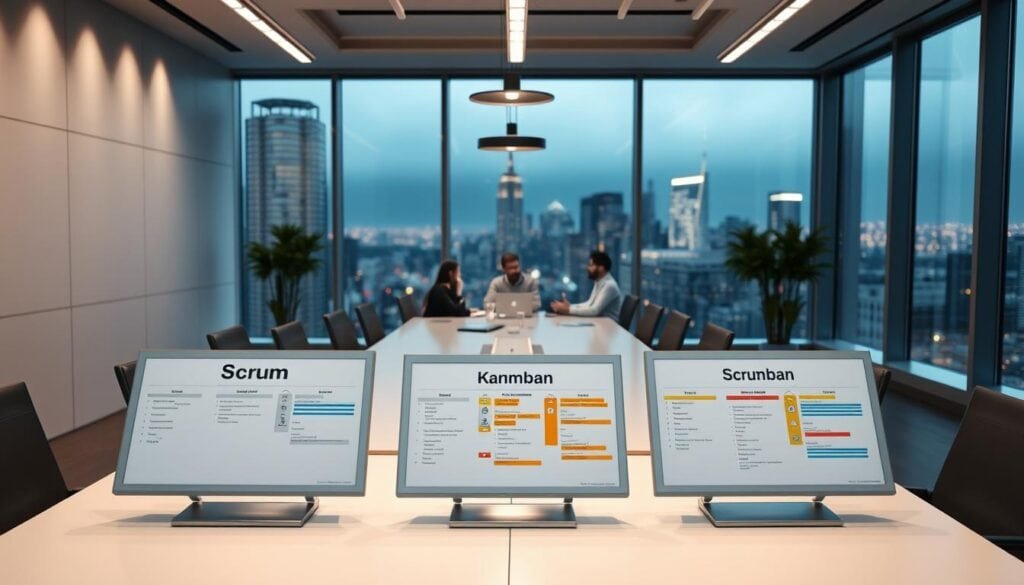
Three distinct frameworks offer pathways to marketing transformation: Scrum, Kanban, and Scrumban. Each provides unique structures for organizing work and managing team flow. The choice depends entirely on your group’s specific context and challenges.
Choosing the Right Framework for Your Team
Scrum operates through fixed time periods called sprints, typically two weeks. This framework suits disciplined teams with stable priorities. It includes defined roles like Scrum Master and Product Owner.
Daily standups and sprint reviews create regular feedback cycles. The structure works well for projects with clear deliverables. However, constant priority shifts can challenge this rigid system.
Kanban takes a visual approach using boards to track task progress. Work flows continuously without fixed timeboxes. This flexibility handles unpredictable workloads effectively.
Work-in-progress limits prevent team overload. The visual nature makes bottlenecks immediately apparent. Kanban suits teams dealing with frequent interruptions.
Adapting Practices to Marketing Needs
Scrumban blends the best of both approaches for marketing contexts. It maintains short cycles while allowing flexibility in duration. Teams can adjust based on campaign demands and capacity.
This hybrid approach often serves as the ideal starting point. It provides structure without excessive rigidity. Teams maintain visual workflows and regular review ceremonies.
The table below compares key framework characteristics:
| Framework | Work Structure | Ideal Team Context | Key Advantage |
|---|---|---|---|
| Scrum | Fixed sprints | Stable priorities | Predictable delivery |
| Kanban | Continuous flow | Variable workload | Flexible capacity |
| Scrumban | Adaptive cycles | Mixed requirements | Balanced approach |
Successful implementation requires customizing these frameworks. Don’t blindly copy software development practices. Modify sprint lengths and ceremony durations to fit your actual workflow.
The right framework matches your team’s rhythm and stakeholder environment. Choose based on your capacity for structure versus need for flexibility.
Steps to Implement Agile Marketing in Your Team
Many teams stumble during implementation by focusing exclusively on process rather than cultural transformation. We see this pattern repeatedly: groups adopt new tools without changing how they think about work. True change requires addressing both mindset and mechanics simultaneously.
Starting with Clear Goals and Sprints
Begin with measurable objectives that define success for your marketing teams. Specific targets like 25% traffic growth or 30% faster campaign launches create focus. These goals guide sprint planning and priority setting.
Cross-functional assembly proves critical. Combine creative, analytical, and strategic perspectives. Diverse team members generate more innovative solutions than siloed specialists.
Framework selection depends on your workflow rhythm. Kanban suits variable workloads while Scrum provides structure for stable priorities. Most marketing teams benefit from Scrumban’s balanced approach.
Establishing Daily Standups and Retrospectives
Daily standups keep work flowing smoothly. These 15-minute sessions coordinate efforts and surface blockers. Team members share progress and align on daily tasks.
Retrospectives complete the improvement cycle. These sessions identify what worked and what needs adjustment. Document insights and implement changes to maintain momentum.
Start with a pilot campaign before scaling across the organization. Prove value with one team, refine your approach, then expand. This measured implementation builds confidence and demonstrates real impact.
Tools and Software to Enhance Agile Marketing Performance
Digital tools should serve your workflow, not dictate it—this principle separates effective implementations from costly failures. The right technology amplifies your team’s capabilities without creating unnecessary complexity.

Project Management and Collaboration Platforms
Platforms like Asana, Trello, and Jira form the foundation of productive operations. These systems manage tasks, track progress, and facilitate seamless communication across departments.
Communication tools like Slack and Microsoft Teams eliminate email bottlenecks. They create organized channels where conversations remain visible and searchable. Collaboration software such as Mural enables remote teams to brainstorm and co-create effectively.
Visualizing Workflows with Kanban Boards
Kanban boards transform abstract work into tangible progress. Tasks move through clear stages: Backlog → To Do → In Progress → Review → Done. This visualization makes bottlenecks immediately apparent.
The transparency builds trust with stakeholders. Executives can view work status without interrupting the team. Integration with CRM systems like HubSpot ensures campaigns align with actual customer data.
Start with one core platform and prove value before expanding. Over-engineered tech stacks often consume more time than they save.
Benefits and Impact of Agile Marketing on ROI and Efficiency
We measure success not by activity but by tangible business impact. The real power of this approach reveals itself through measurable improvements across multiple dimensions.
Teams achieve faster campaign deployment by breaking large projects into focused sprints. This accelerated time-to-market lets businesses capitalize on trends before competitors even finish planning.
Accelerated Time-to-Market
Speed becomes a competitive advantage in digital environments. While traditional groups navigate approval cycles, agile teams launch, test, and iterate campaigns in real-time.
Content reaches audiences when it’s relevant rather than outdated. This responsiveness transforms marketing from reactive to proactive.
Data-Driven Improvements and Continuous Delivery
Continuous improvement becomes systematic through relentless data collection. Teams paint vivid pictures of customer preferences that fuel increasingly targeted efforts.
A/B testing exemplifies this approach—data determines winners instead of debates. Resources allocate more effectively through smaller, targeted tests that scale what works.
The benefits extend beyond metrics: predictable workloads reduce chaos, credibility builds through consistent delivery, and customers receive value in frequent increments.
Overcoming Challenges and Debunking Agile Marketing Myths
Transformation efforts often stumble on predictable roadblocks that derail even the most promising initiatives. We see teams encounter the same patterns regardless of industry or organization size.
Identifying Common Obstacles
Resistance to change tops the list of adoption challenges. Team members comfortable with traditional processes often view new approaches as disruptive fads. This skepticism grows when groups have experienced previous failed transformation efforts.
Lack of executive buy-in undermines implementation before it starts. Leaders who don’t understand the methodology continue adding urgent requests mid-sprint. They judge success by outdated metrics rather than customer value delivered.
Inconsistent stakeholder involvement creates workflow chaos. When partners disappear during sprints then demand changes at launch, teams waste effort reworking completed tasks.
Effective Strategies for Agile Adoption
Effective adoption begins with comprehensive education. Train team members on why and how before changing processes. Appoint champions who model desired behaviors and coach others.
Celebrate early wins to build momentum. Implement changes gradually rather than attempting overnight transformation. This prevents overwhelming everyone involved in the transition.
Set crystal-clear sprint goals and maintain rigorously prioritized backlogs. Limit work-in-progress and empower decision-makers to say “no” to misaligned requests. Document what adds value while eliminating bureaucratic paperwork.
| Common Challenge | Effective Solution | Key Benefit |
|---|---|---|
| Resistance to change | Comprehensive training & champions | Cultural buy-in |
| Scope creep | Clear sprint goals & backlog discipline | Focus maintenance |
| Stakeholder inconsistency | Regular feedback cycles | Workflow stability |
| Scaling complexity | Gradual implementation | Sustainable growth |
The agile approach requires addressing both mindset and mechanics simultaneously. Success comes from combining strong leadership with practical workflow adjustments that deliver measurable results.
Real-World Examples and Best Practices in Agile Marketing
Success stories from actual marketing operations reveal patterns that separate winning teams from stagnant ones. We see consistent results across industries when groups implement these principles effectively.
Case Studies from Modern Marketing Teams
An e-commerce company transformed their campaign launch process using Scrumban. They reduced deployment time from 12 weeks to just 3 weeks. This allowed them to capitalize on seasonal trends competitors missed.
A B2B SaaS group struggling with unpredictable workloads adopted Kanban with work-in-progress limits. They achieved 40% faster content delivery and significantly reduced team stress. Writers could focus deeply on fewer pieces rather than juggling dozens.
These examples demonstrate how the right framework creates sustainable success. Teams initially skeptical about “more meetings” quickly appreciate the transparency and predictability.
Key Takeaways for Sustainable Success
Maintain a clear, prioritized marketing backlog as your single source of truth. This ensures teams focus on crucial tasks aligned with business goals. They can swiftly adapt when priorities shift.
Embrace data-driven decision-making across all campaigns. Collect performance data from multiple sources and analyze it regularly. Use insights to inform strategy adjustments in real time.
The most successful implementations combine structure with flexibility. They establish consistent rhythms while remaining adaptable about tactics. This balance creates long-term results.
| Traditional Practice | Agile Best Practice | Business Impact |
|---|---|---|
| Fixed annual plans | Adaptive quarterly goals | Market responsiveness |
| Volume-focused output | Value-driven delivery | Measurable ROI |
| Departmental silos | Cross-functional collaboration | Integrated execution |
| Delayed feedback loops | Continuous optimization | Real-time improvement |
For more detailed agile marketing examples and case studies, explore our comprehensive resource library. These real-world stories provide actionable insights for your team’s transformation journey.
Conclusion
Effective implementation transcends process adoption to become a fundamental rethinking of how value gets delivered. This agile marketing approach represents a complete operating system—not borrowed practices superficially applied.
True transformation reshapes how your team influences strategy and builds credibility. It requires aligning mindset, culture, and workflow in one integrated system.
Your path depends on context. Start with pilot campaigns, choose frameworks that fit your work patterns, and scale gradually. The principles—customer focus, adaptability, continuous improvement—matter more than any specific tool.
Leadership commitment to coaching empowers team members to experiment and learn. The rewards are substantial: faster deployment, improved ROI, and happier customers.
Begin now with small changes. This marketing methodology thrives on iteration. Build competence through practice rather than waiting for perfect conditions.
FAQ
What is the primary difference between traditional marketing and an agile approach?
Traditional marketing often relies on rigid, long-term plans that struggle with change. In contrast, an agile framework focuses on flexibility, short cycles called sprints, and adapting to customer feedback and market shifts in real-time. This allows teams to deliver value faster and more efficiently.
How do team members collaborate effectively within an agile system?
Effective collaboration hinges on clear roles, daily standup meetings, and transparent workflows. Using tools like Kanban boards, teams visualize tasks, track progress, and maintain alignment on priorities. This fosters a culture of shared responsibility and continuous improvement.
Can small businesses benefit from implementing agile marketing?
Absolutely. The principles of agile are scalable. Small teams can use this approach to respond quickly to customer needs, test strategies with minimal resources, and improve their return on investment by focusing on high-impact tasks. It’s about working smarter, not just harder.
What are some common tools used to manage an agile workflow?
A> Popular platforms include Trello, Asana, and Jira for project management. These tools help in planning sprints, assigning tasks, and visualizing progress through boards. The right software enhances collaboration and keeps the entire team focused on strategic goals.
How does an agile methodology improve a team’s ability to handle changing priorities?
By breaking work into short sprints and holding regular retrospectives, teams can quickly reassess goals and shift focus based on new data or customer insights. This process embeds adaptability into the core strategy, turning potential disruptions into opportunities.